Portfolio HomeAbout Me

My journey

2010-2014

Bachelors in Computer Science and Engineering

My undergrad was in Computer Science and Engineering. I am fascinated by how technology.

2014-2018

Software Developer

My undergrad was in Computer Science and Engineering. I am fascinated by how technology.

2010-2014

Bachelors in Computer Science and Engineering

My undergrad was in Computer Science and Engineering. I am fascinated by how technology.

2014-2018

Software Developer

My undergrad was in Computer Science and Engineering. I am fascinated by how technology.

EXPERIENCE

UX Office, Indiana University UX Testing Coordinator

Aug 2019 - Current | Bloomington, IN

Collaborate with the User Experience Office and university software teams to conduct User Research and Usability testing to identify product improvements, user pain points, and opportunity spaces.

Zoro.com UX Research Intern

2.5 mos | Jun - Aug 2019 | Chicago, IL

Improved the customer experience of the shopping cart and checkout funnel of the eCommerce product by performing extensive user research, analyzed customer shopping behavior, attitude and pain points, synthesized qualitative and quantitative research data to generate insights, conceptualized design solutions, and generated wireframes.

SAP Labs Software Developer

Jun 2014 - Jul 2018 | Bangalore, India

Translated UI wireframes and mockups to high-fidelity functional prototypes and responsive, interactive features using SAP UI5, D3 controls, HTML, JavaScript and CSS for SAP Analytics desktop and mobile apps.

Collaborated cross-functionally with the UX, Product Management, Engineering and Documentation team from early implementation to deployment of products in an Agile setting.

PROJECT DETAILS

Design Tool
Sketch, Miro
Role
UX Design Intern
Timeline
Jun - Aug 2019
Status
Live on Zoro.com Web and Mobile

Zoro Shopping Experience

Background

Zoro.com is an eCommerce platform that sells business supplies, equipment, and tools. I was part of one of the most creative and innovative team of User Experience Researchers and Designers to make sure the folks who visit the website have a fantastic experience.

I collaborated as a part of the Buy team which is responsible for the customers progress through the Check Out funnel from adding a product to cart to order confirmation.

The Outcome

Here is the outcome of my UX Research and Design work during the 2.5 months of the course of my internship-
1. Reduction in customer drop outs at the Login step of Check Out.
2. Improved customer satisfaction as they progress through the Check Out funnel.
3. Increase in Check Out conversions to Order Complete.
4. Reduction in customer service calls and emails regarding Shipping and Delivery related queries such as delivery availability, date and type.
5. Reduction on queries regarding return policy and in-stock.
6. Improved conversion and revenue for items that are eligible for expedited shipping.
7. Improved user experience, less friction, simple and modern design.

UX Process

During the span of my internship, I collaborated cross-functionally with the UX, Product, Merchandising and Engineering teams on many exciting projects of which some have completed production and is live on the site. Here is a brief overview of the UX process and methods that I used at different stages of my internship -

Discovery

Body Storming
Diary Study
Heuristic Evaluation
Ecommerce Benchmarking
Google Analytics

Exploration

Contextual Inquiry
Field Visits
Customer calls monitoring
Clicktale Analysis
Competitive Analysis

Design

Affinity Mapping
Whiteboarding
User-flow mapping
Wireframing
Short and long term ideation

Testing

Design Review
Feedback & Iteration
Redesign

Body Storming and Diary Study

Understanding Zoro and its customers

Before beginning my work on any projects, I needed to understand thoroughly about Zoro, its customers and the current customer experience. So, with my fresh pair of eyes, I role-played as a Zoro customer to not only become familiar with the product but also sympathize and empathize with the customer needs and struggles.

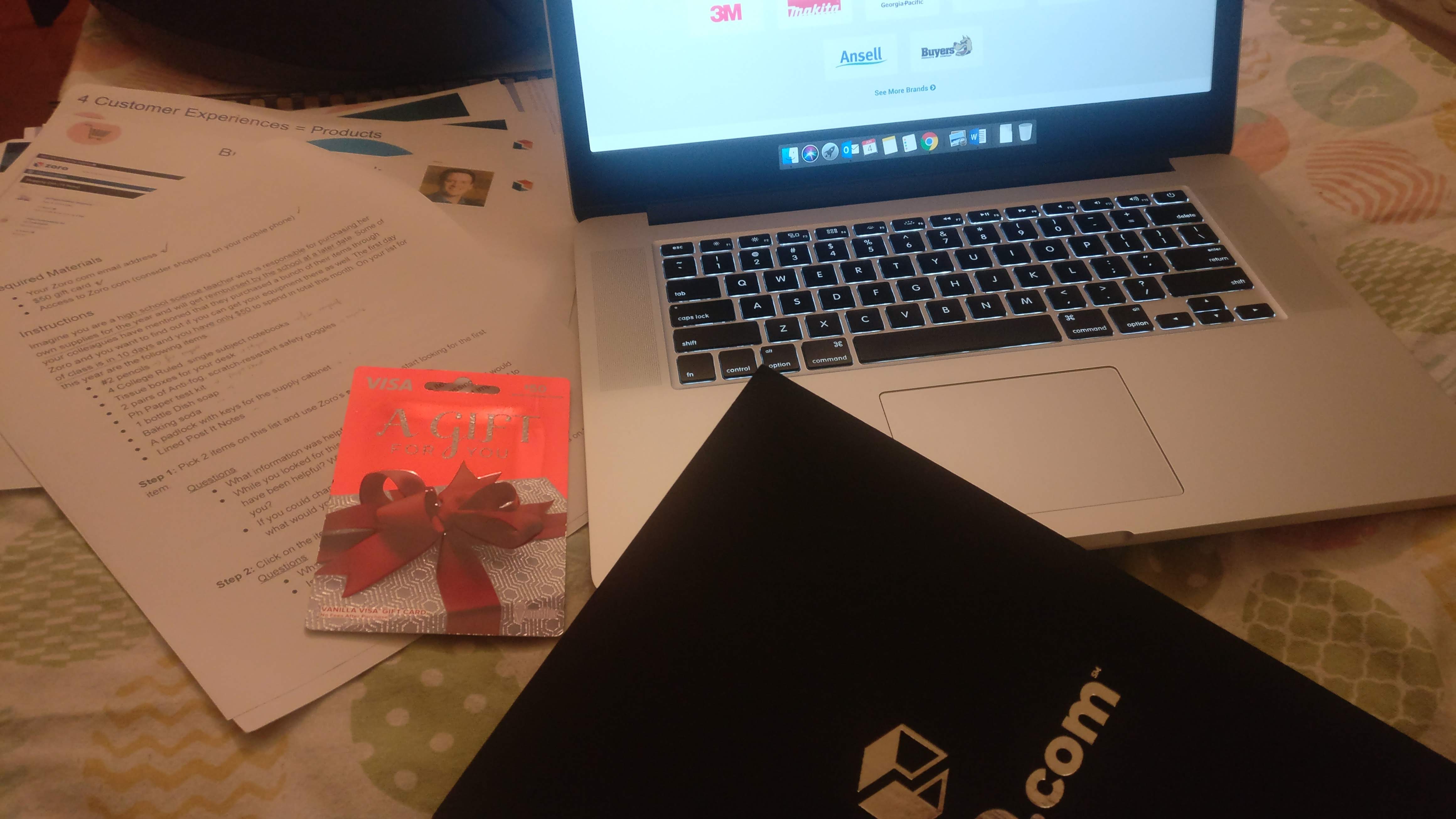
I role-played as a high school science teacher persona who is in need of supplies within a limited budget before the school year started. This body storming activity helped me to get started with developing a holistic understanding of the product.

After placing the order, I did diary study to map my experience of tracking the order, placing customer calls and unboxing the items. This way I was able have insights into the experience beyond Zoro's digital platform to talking to the customer service agents and overall experience.

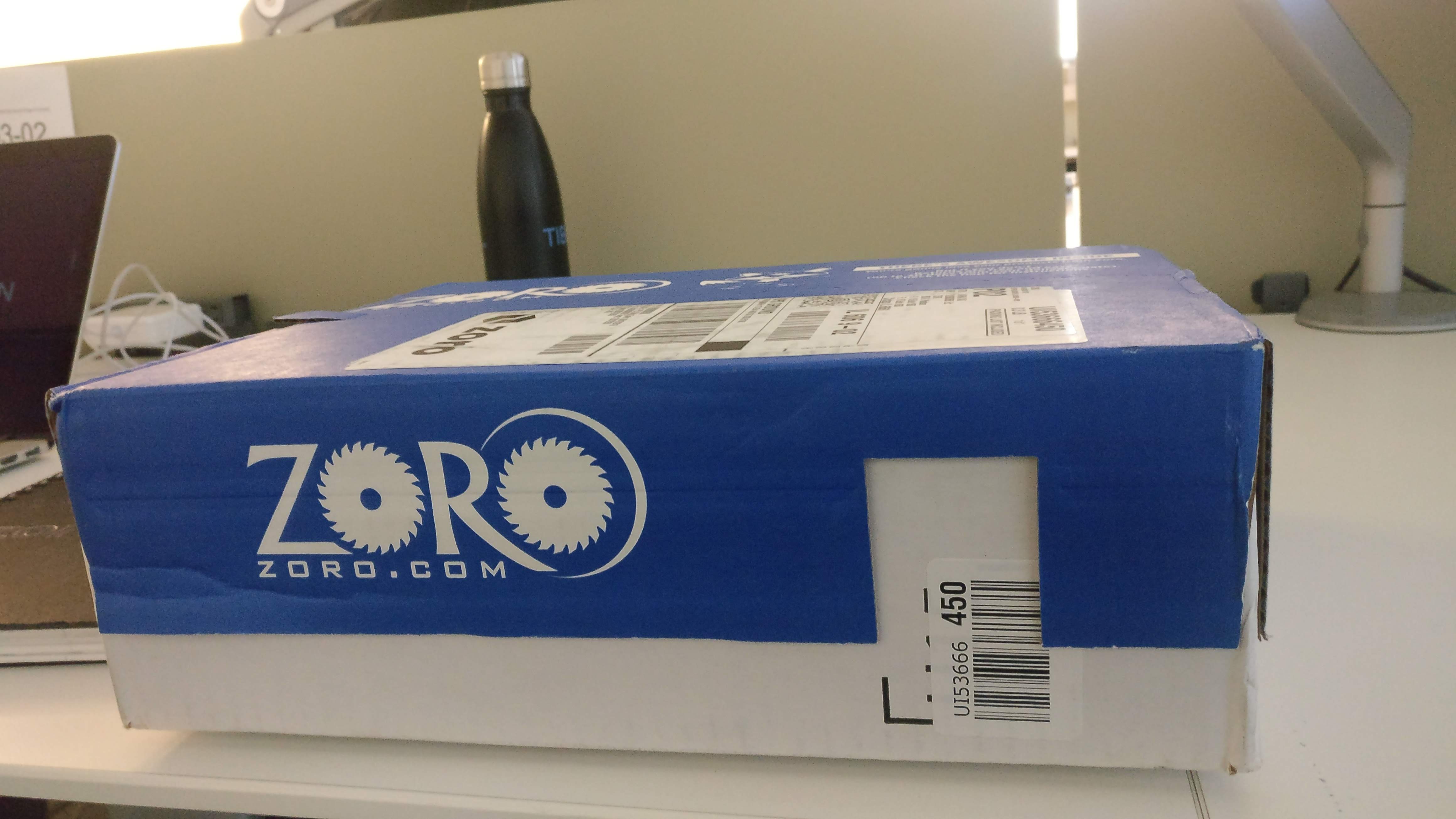
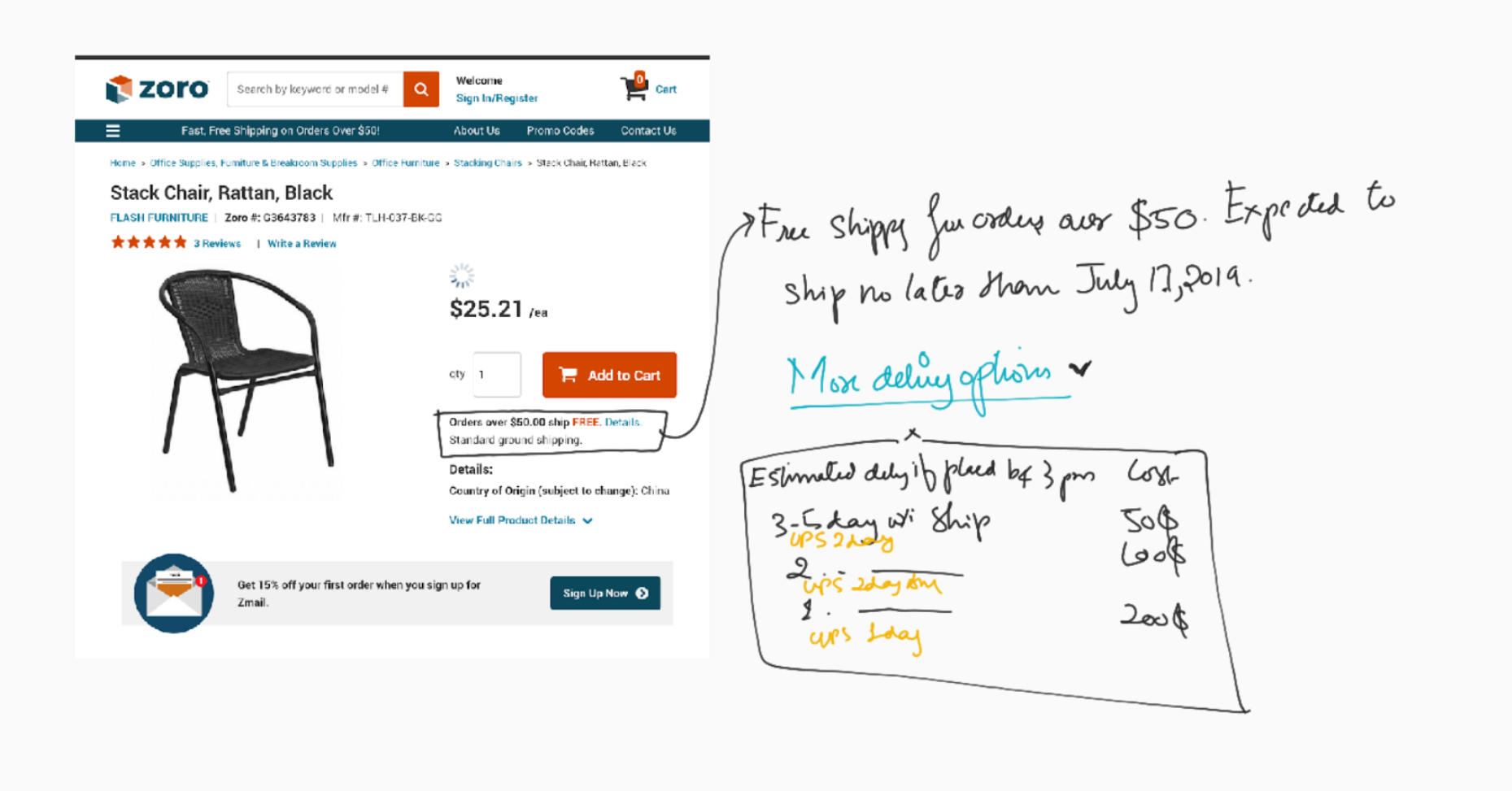
One of my purchases from Zoro.com

Before beginning my work on any projects, I needed to understand thoroughly about Zoro, its customers and the current customer experience. So, with my fresh pair of eyes, I role-played as a high school science teacher persona in need of supplies within a limited budget before the school year started. After placing the order, I did diary study to map my experience of tracking the order, placing customer calls and un-boxing the items.

Takeaway :

Body storming and Diary Study helped me to get started with developing a holistic understanding of Zoro. This way I was able have insights into the customers experience beyond Zoro's digital platform to interacting with customer service and receiving the product.

One of my purchases from Zoro.com
Initial Discovery from Google Analytics Data, Heuristic Evaluation and Benchmarking

"From cart to complete order", Why do customers abandon Check Out?

I conducted heuristic evaluation and e-commerce benchmarking of the Shopping Cart and Checkout funnel of Zoro.com using Baymard Guidelines. I examined all the steps, flows, microcopy, and the things that could go wrong in this extremely important stage of users purchasing cycle and created recommendation to design a checkout that as few needless abandonment's as at all possible.
Baymard Analysis of the Current State Check Out
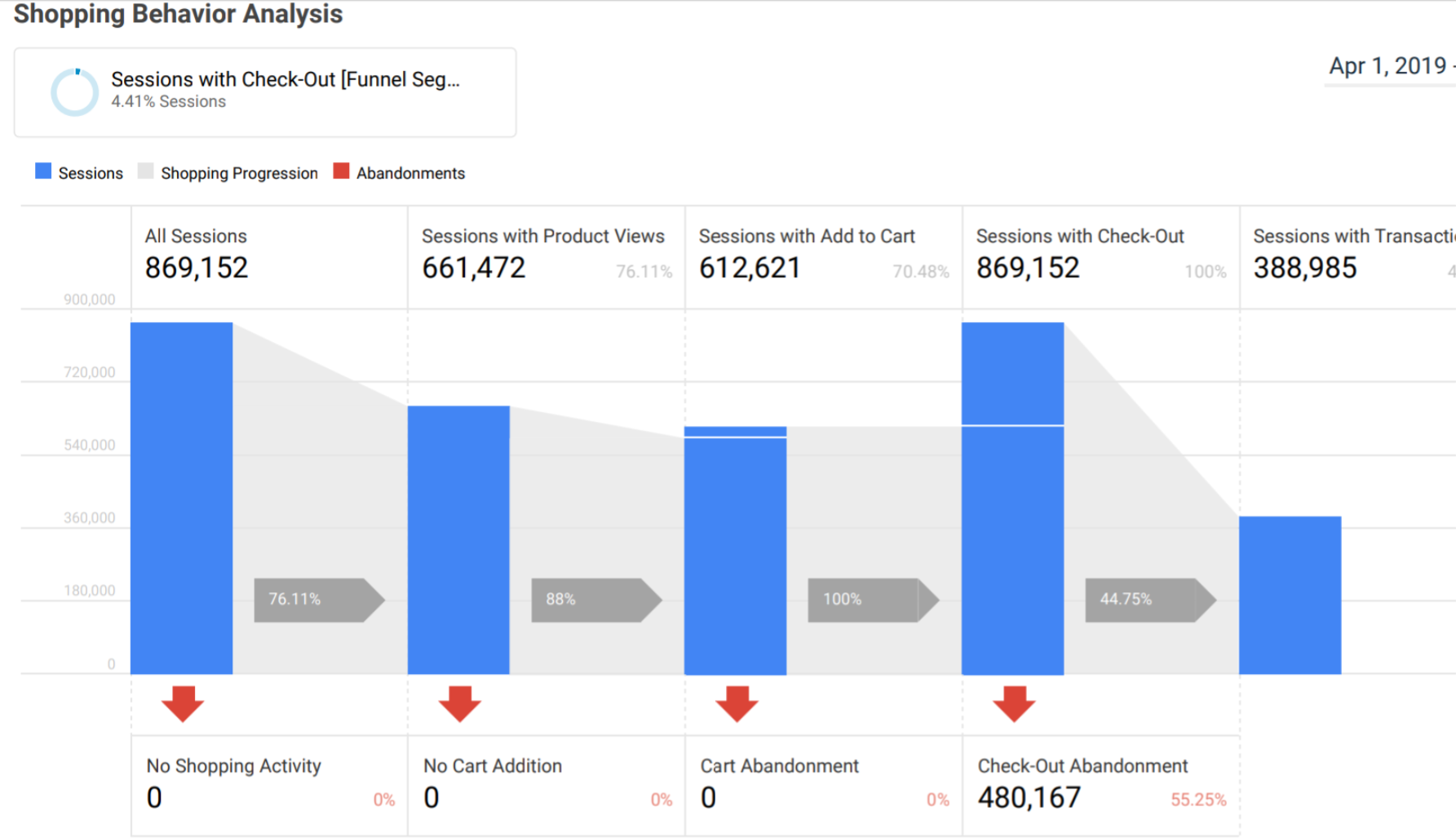
Google Analytics of Customer Shopping Behavior of Check Out
I was also interested in knowing what the customers are doing on the website, where they are coming from, how long they get engaged, and the ways I can improve it. The customers shopping behavior analysis showed a 55% Check-out abandonment rate after having added items to cart.
Read my initial discovery in detail

From the Baymard evaluation and bench-marking I learned that two of the main areas in which Zoro was performing below or even negative score were the Shipping and Store Pickup and Shopping Cart and Added to Cart Behavior categories. Within these categories, majority of the pain points was around how shipping and delivery information was presented throughout the website.

There was a lack of clarity for the customers about the total order cost, shipping and delivery speed, time, return and other details around shipping, right from the product detail page to shopping cart to check-out which lead to the check-out process being extremely complicated and caused abandonment. In addition, I also learned that login step in the flow of cart to check-out was also a major adding to the complication of making a successful purchase. Based on the insights from my research I narrowed down my problem space to two main areas-

  • Shipping and Store Pickup- Within these categories, majority of the pain points were around how shipping and delivery information was presented throughout the website.

  • Shopping Cart and Added to Cart Behavior- There was a lack of clarity for the customers about the total order cost, shipping and delivery speed, time, return and other details around shipping, right from the product detail page to shopping cart to check-out which lead to the check-out process being extremely complicated and caused abandonment.

  • Login within Check Out flow- In addition, I also learned that login step in the flow of cart to check-out was also a major adding to the complication of making a successful purchase.

See more of my Baymard Analysis

Based on my research, the three of the main areas Zoro was performing low were-

Shipping and Store Pickup
There was a lack of clarity about the total order cost, shipping and delivery speed, time, return and other details around shipping.

Add to Cart BehaviorWithin this category, majority of the pain points were around the Addto Cart interaction

Login within Check Out flowIn addition, I also learned that the login step within the flow of Cart to Check Out was adding to the complication of making a successful purchase.

Based on the insights from my research I narrowed down my problem space to two main areas-

Defining the Problem

01

How might we create a better shipping experience for the customers?

02

How might we improve the guest & authenticated Check Out experience?


01

How might we create a better shipping experience for the customers?

02

How might we improve the guest & authenticated Check Out experience?

Based on my research exploration so far, I worked on the two problems/projects as well as did an additional project to conduct usability study for integrating Alexa with Zoro for voice based e-commerce shopping.

Project 1- Creating a better shipping experience for customers.
Project 2- Improving the Check-Out experience.
Project 3- Usability test for Alexa integration with Zoro.

Process

After my initial exploratory research, to understand and asses deeper about customers practices and behaviors, I conducted qualitative research including contextual observation, clicktale analysis, competitive analysis and more. I partnered with the customer experience intern and the merchandising intern for this part of my project. We consolidated and synthesized all the data we collected from the multiple research methods, generated insights and conceptualized for short term and long term designs. After the conceptualization, I did a white-boarding session to map out the user flows and finally created wireframes.

Research

Contextual Inquiry of Customer Service Agents.
Listened to 20+ Customer Calls. Field Visit to Janesville and Minooka Distribution Center.
Analysed Clicktale Recordings and Heatmaps.
Competitive Analysis.

Synthesis

Affinity Mapping.
Semantic Differential.

Conceptualizing

Short term and long term ideas.
User flow mapping.
White-boarding.
Presentation and Feedback gathering.

Wireframing

Wireframing.
Feedback and Iteration.
High Fidelity Mockups.

Realizing the importance of not only creating a great customer experience but also a great agent experience

Contextual Inquiry

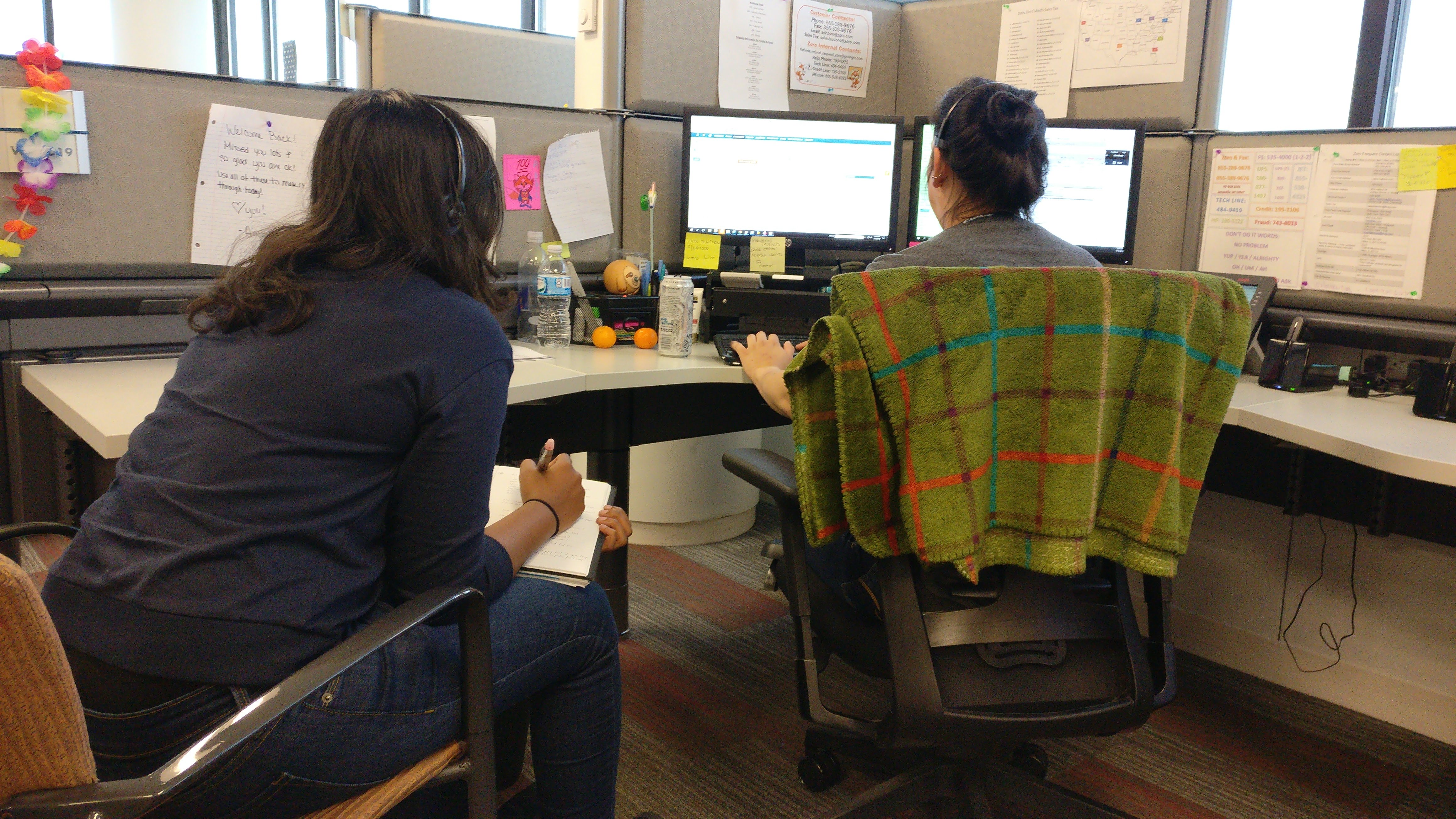
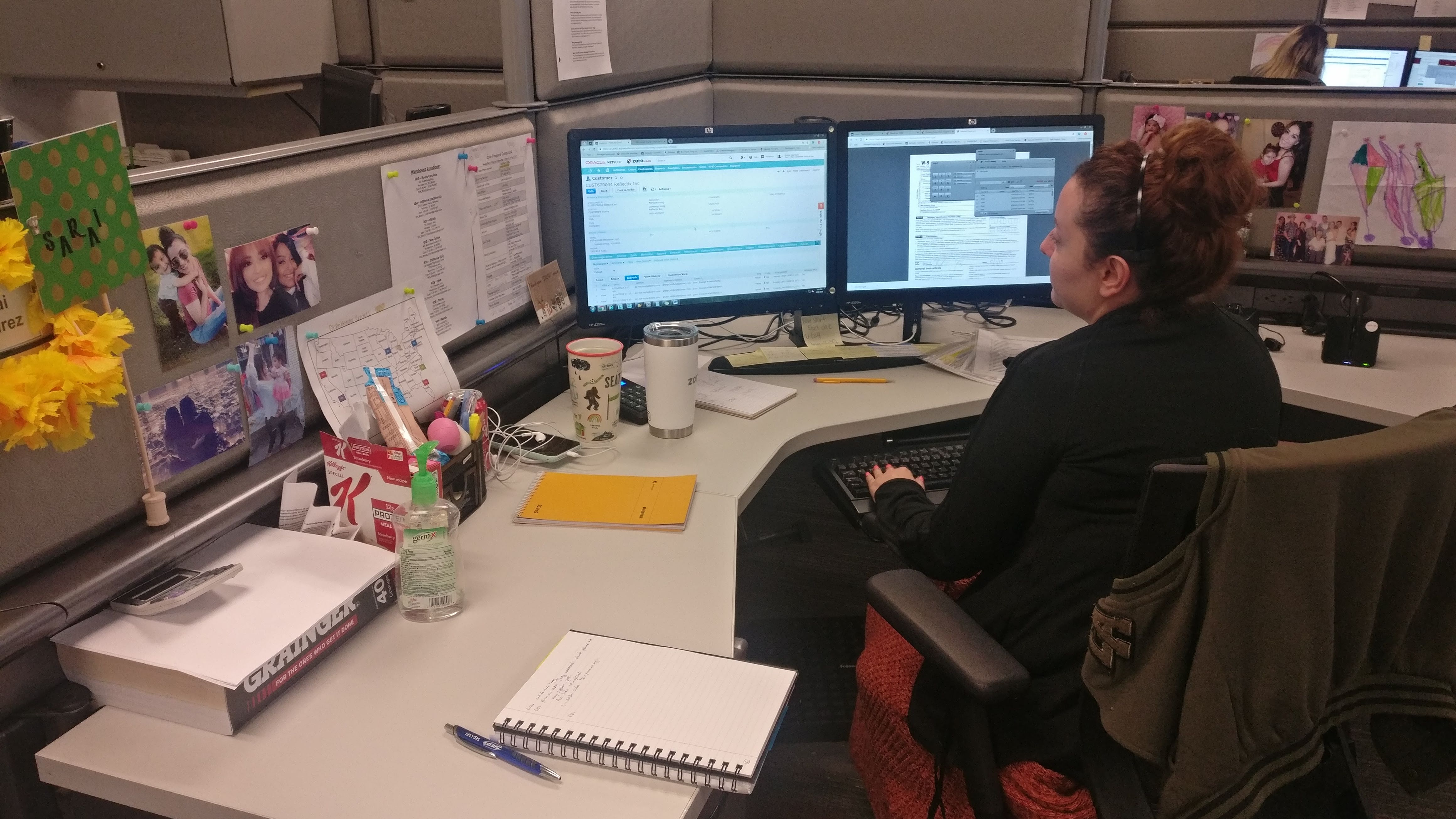
Customer service agents being one of the primary stakeholders and the voice of Zoro customers, it was imperative to observe them in their natural context. I observed them attending call after calls and handling multiple processes such as using Netsuite, SAP, Email, Slack, placing calls to other departments etc. at the same time and other applications to assist customers. They are essentially like superheros and go above and beyond to help a customer in need. I realized the importance of not only creating a great customer experience but also great agent experience.

I listened to over 20 customers calls over the course of 2 visits, noting key data points about customers, agents and the issues discussed in each call. This method of inquiry & observation contributed excellently to my goal of understanding the shipping experience from both the stakeholders and customers perspective.

Customer service agents being one of the primary stakeholders and the voice of Zoro customers, it was imperative to observe them in their natural context. I observed them attending call after calls and handling multiple processes such as using Netsuite, SAP, Email, Slack, placing calls to other departments etc. at the same time and other applications to assist customers. I realized the importance of not only creating a great customer experience but also great agent experience.

I listened to over 20 customers calls over the course of 2 visits, noting key data points about customers, agents and the issues discussed in each call.

Contextual Inquiry at the Customer Service Office, Janesville, WI
Customer Service Agent at work
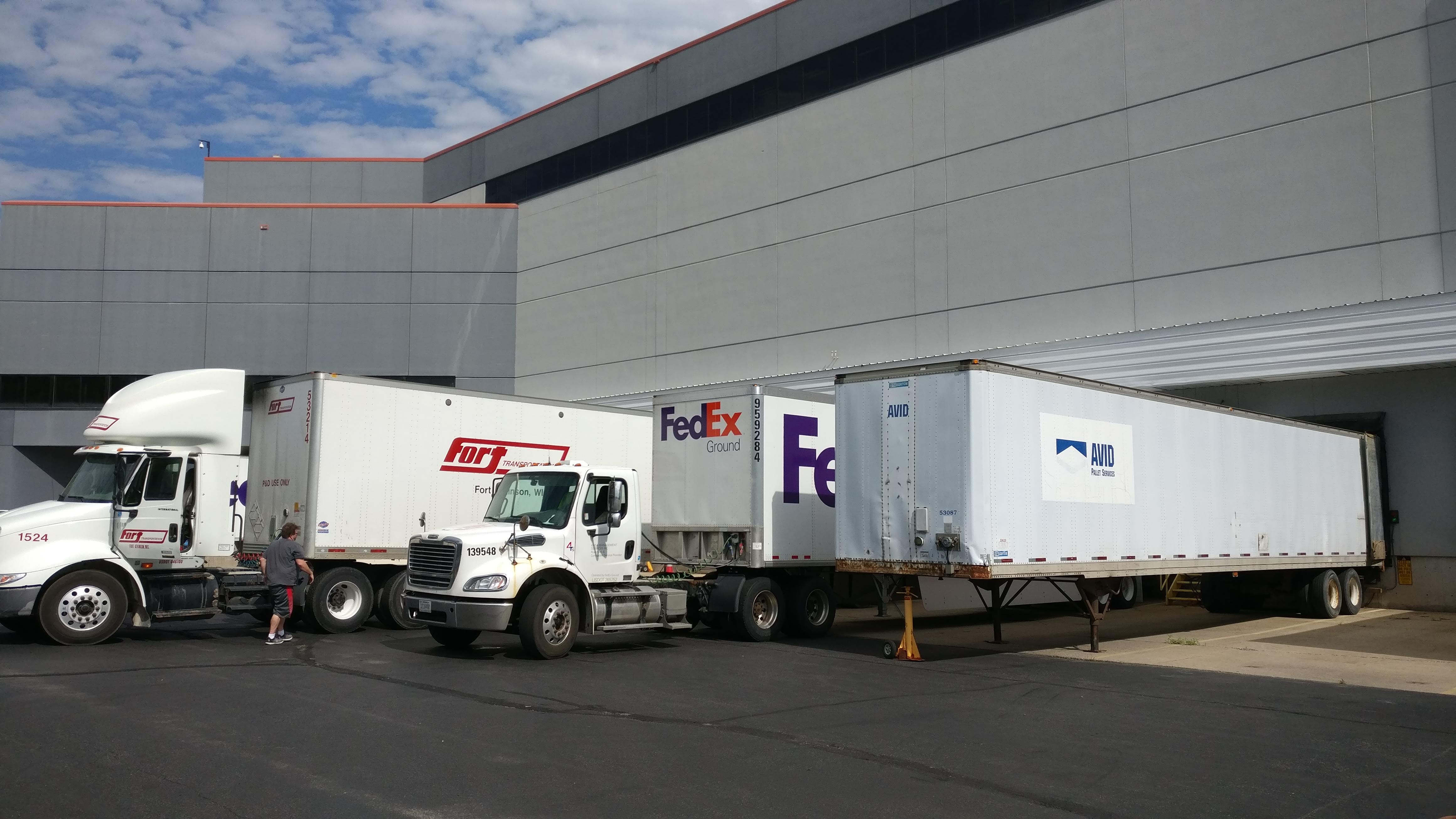
Field Visit to Minooka Distribution Center

Findings from the research

My assumption was that customers do not prefer to pickup the phone and talk to someone unless they absolutely have to. This creates the need for customers to have different options or channels to interact with.

But, from my research, I learned that majority of the post-purchase customers calls are related to shipping and shipment tracking issues which includes expedited shipping cost, stock, time and promos mainly because it is easier and hassle free compared to having to check the website. The customers are confused about shipment status, timing, or even verifying that the time they were quoted was accurate. Here are the main findings -

Customers would like to know the availability of expedited shipping options upfront

Right now they don't know till the check out screen.

Find-ability of available expedited shipping options in the Product Details Page

This shows the need for more noticeable shipping information and better microcopy for the delivery options and time.

Need more clarity on cut-off time

A lot of customers do not read the "business days” which makes them believe that if they are to place an order at 5 pm on Saturday, that they will receive the order Sunday. This shows the need for providing more clarity on the cutoff time.

Shipping cost calculation

The expedited shipping cost is calculated out of IL distribution center hence its extremely expensive. This indicates the need for better shipping cost calculation.

"Do customers call/email us about expedited shipping? Yes, I probably receive at least 4-5 calls a day about expedited shipping. It usually starts with stock check calls. When I inform them of our Standard Ground 3-5 business day transit, They ask for expedited shipping possibility."

Clicktale tells the story of customer's behavior

Clicktale Analysis

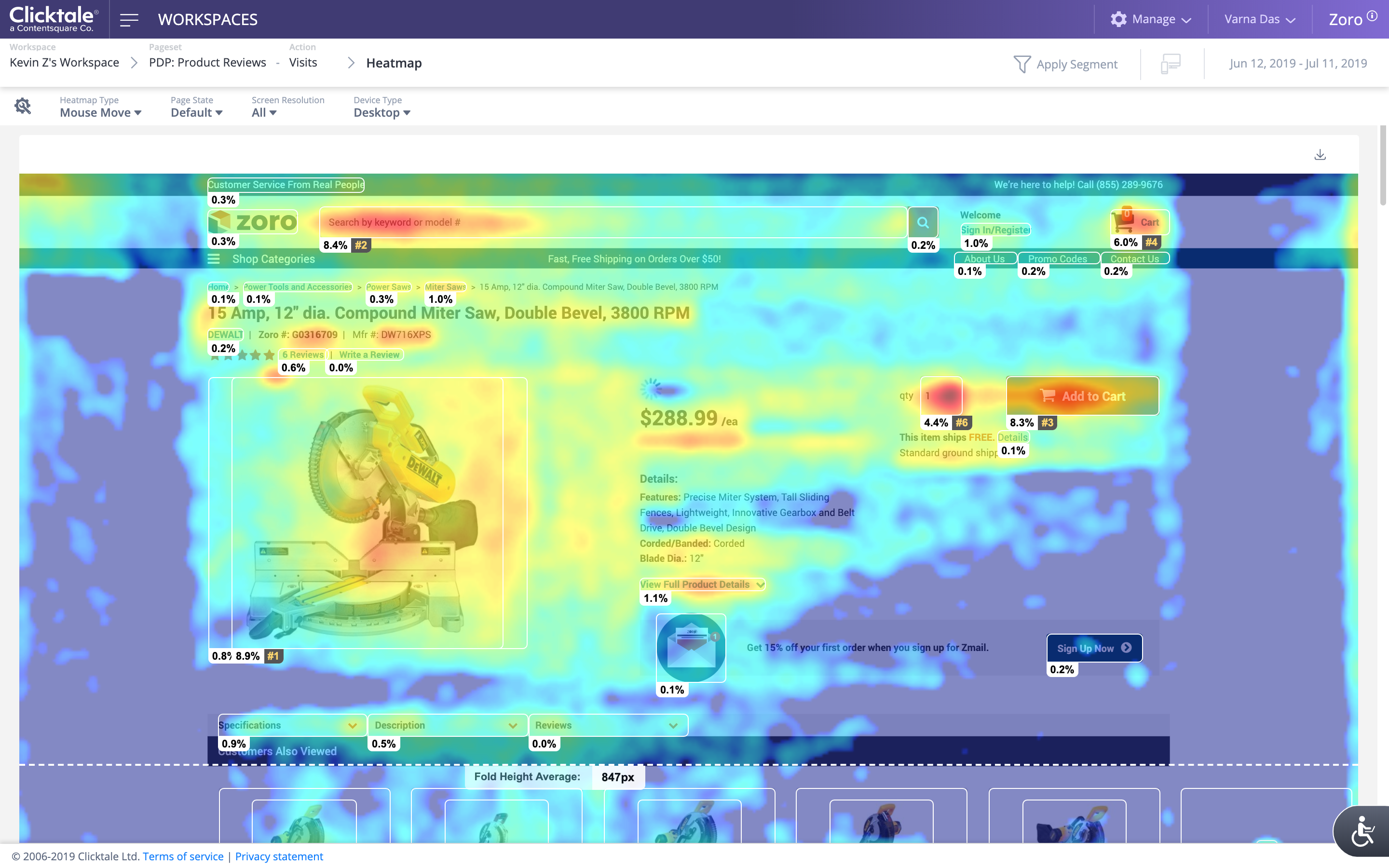
To gain more insights into my contextual inquiry and visualize customers experience from a website perspective I looked at Clicktale kpis, aggregated heatmaps and individual session recordings which heavily supported my insights from the contextual inquiry.

There is very less heat on the Details link which shows the information regarding shipping and the options are not read by most customers.

Heatmap of the Product Details Page

Synthesis and Ideation

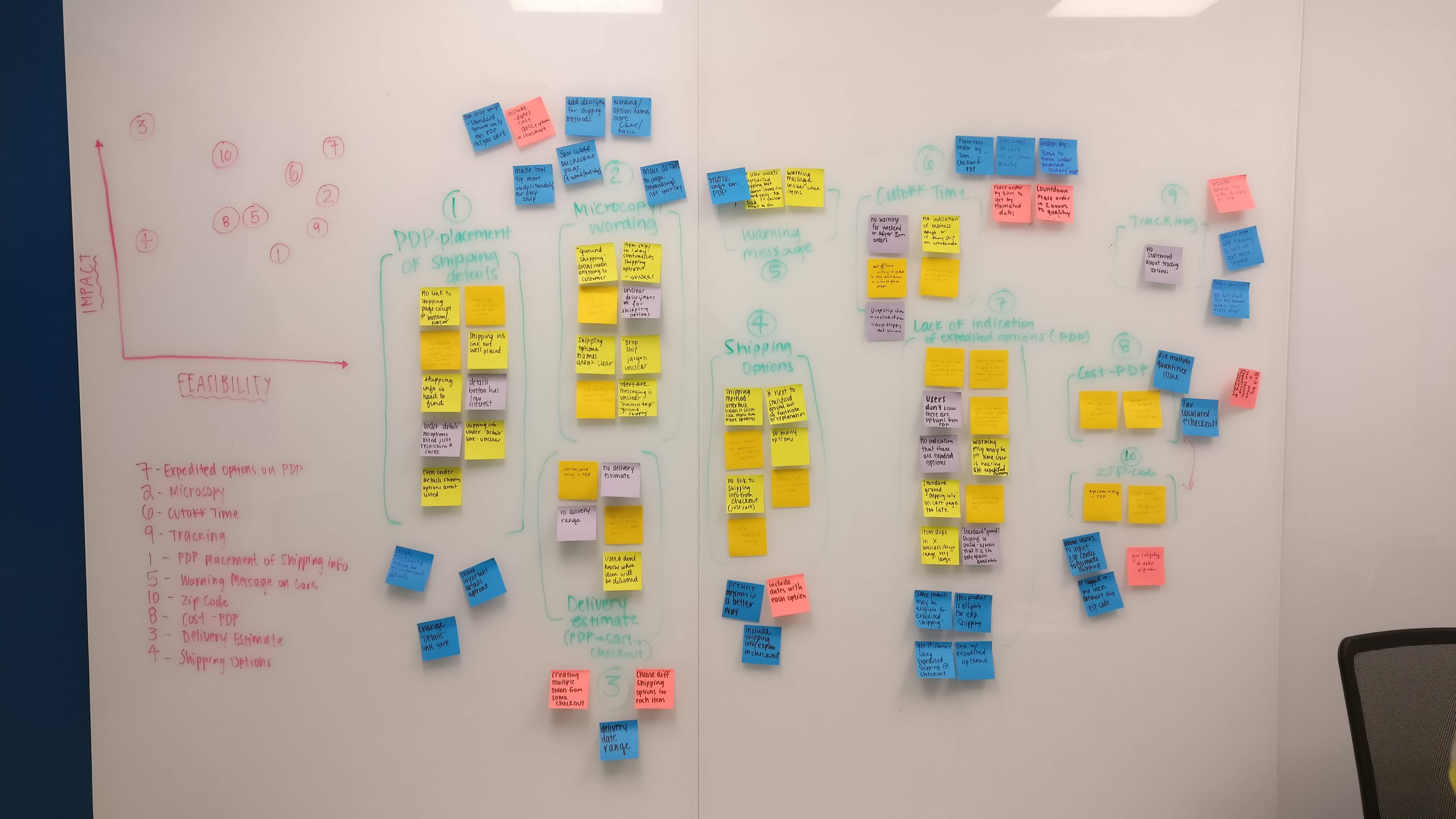
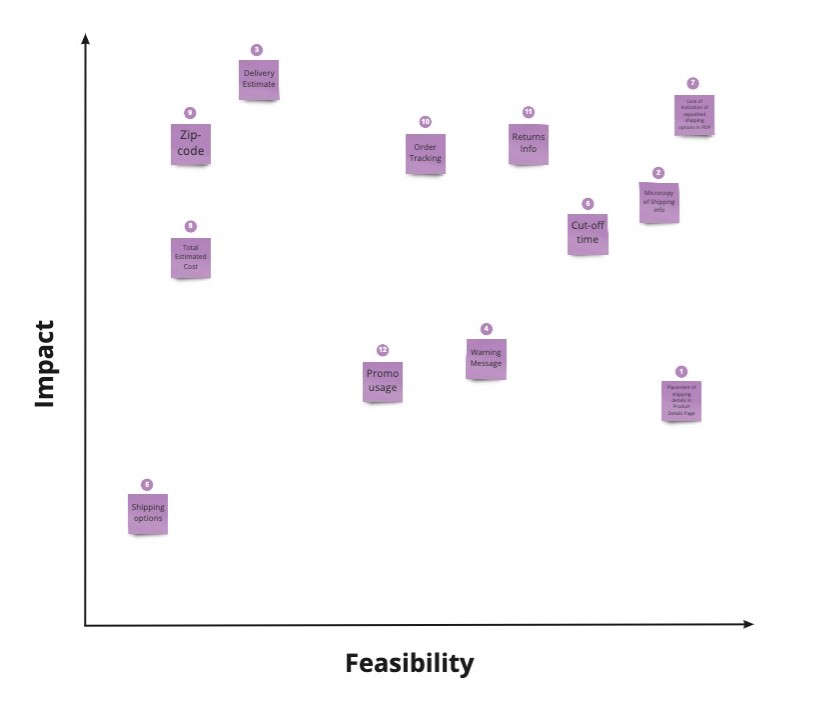
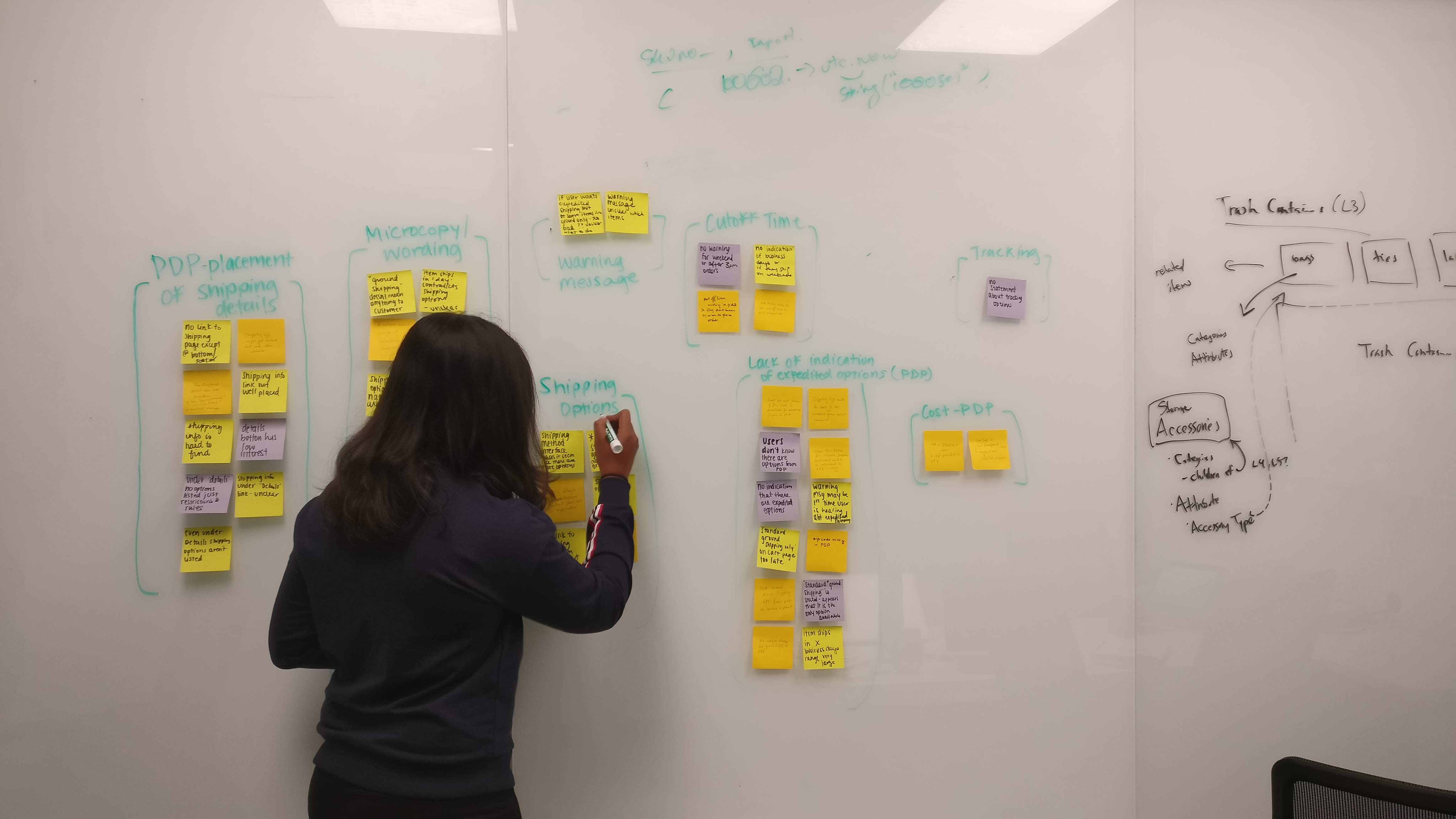
To organize and clarify all the data, observations and thoughts we collected so far we used affinity diagramming method. We generated notes with each data point and observations and sorted them into categories. Once we had clearly defined the main categories, to determine the priority, we mapped it according to feasibility vs impact semantic differential and ideated solutions which where feasible short term and long term.

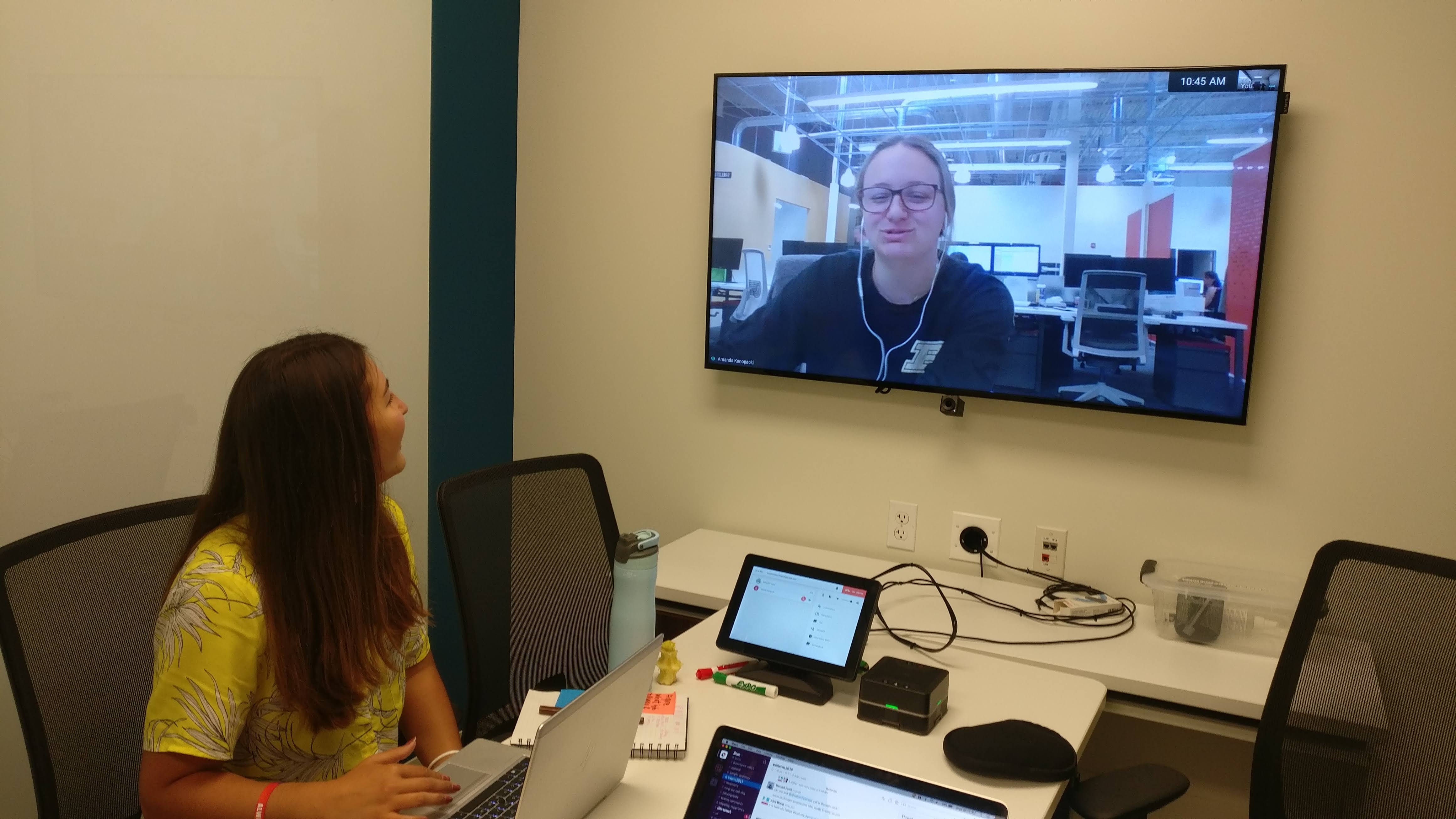
Emma (Customer Experience Intern), Amanda (Merchandising Intern) and I affinity mapping

Short and Long term design opportunities

Only Long term design opportunities

1

Indication the possibility of Expedited Shipping and its options in Product Details Page.

2

Improve and clarify the Microcopy of shipping information in the Product Details Page, Cart and Check out.

3

Add Product Returns information in the Product Details Page.

4

Add shipping cut-off time.

6

Provide Total Order Cost and Shipping cost in Product Details Page.

7

Warning Message

1

Provide a delivery estimate.

2

Add geo-location tagging feature and zip code changing options from Product Details Page(PDP).

3

Provide Estimated Total Order Cost upfront from PDP to cart to chck out.

Out of Scope

1

Modify Shipping options

2

Add order tracking

3

Promo usage

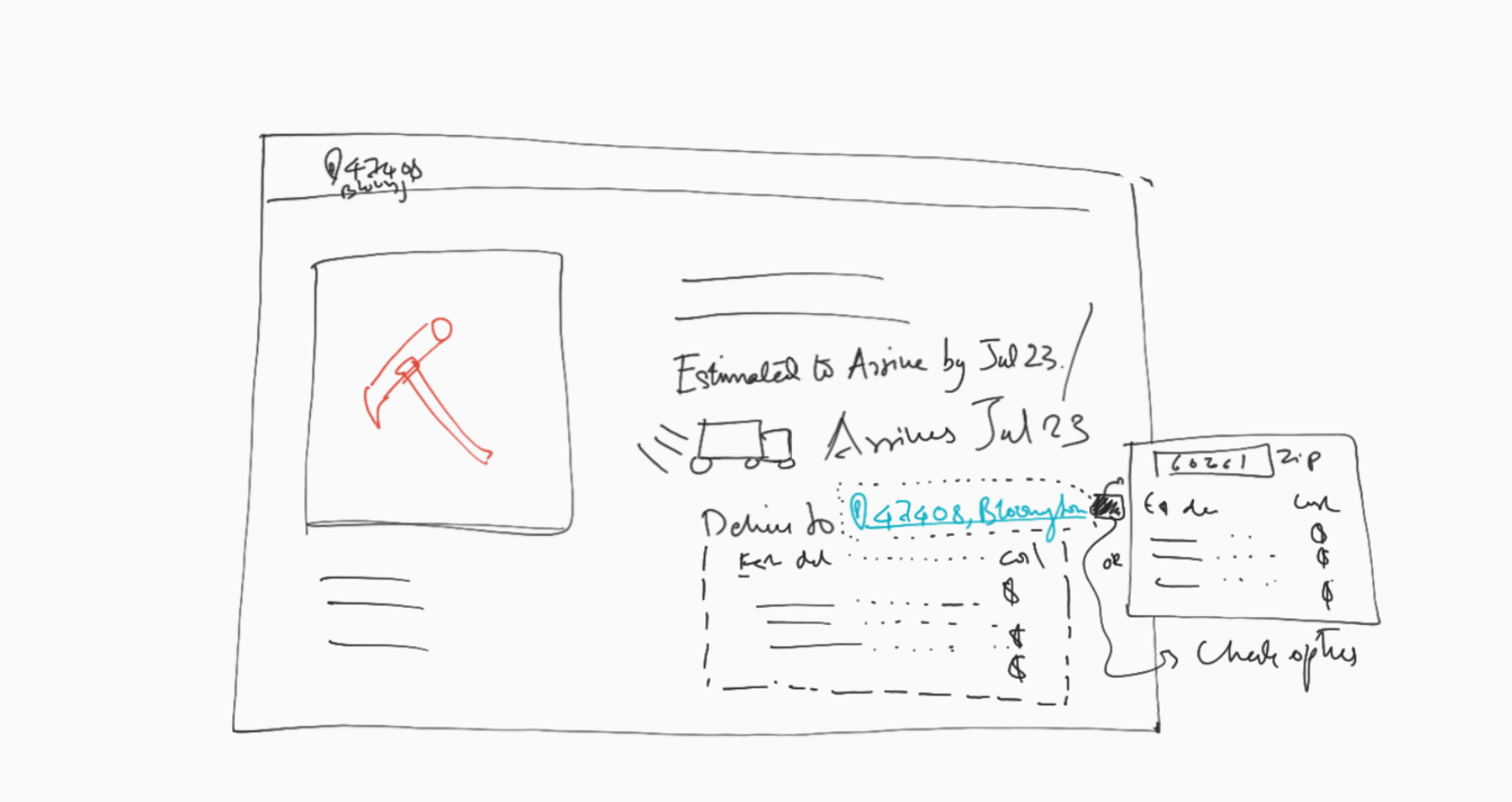
Mapping User flows and white-boarding

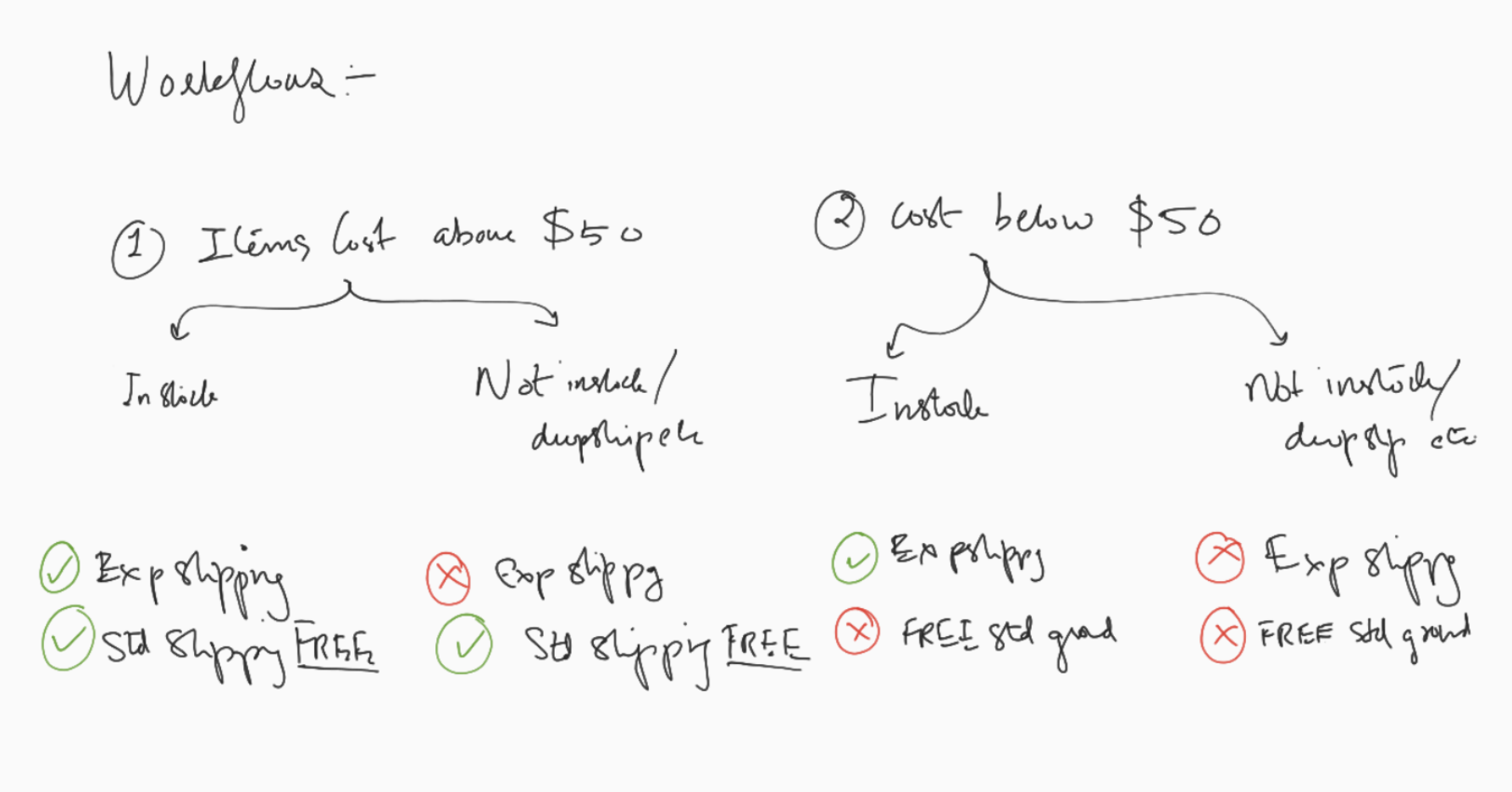
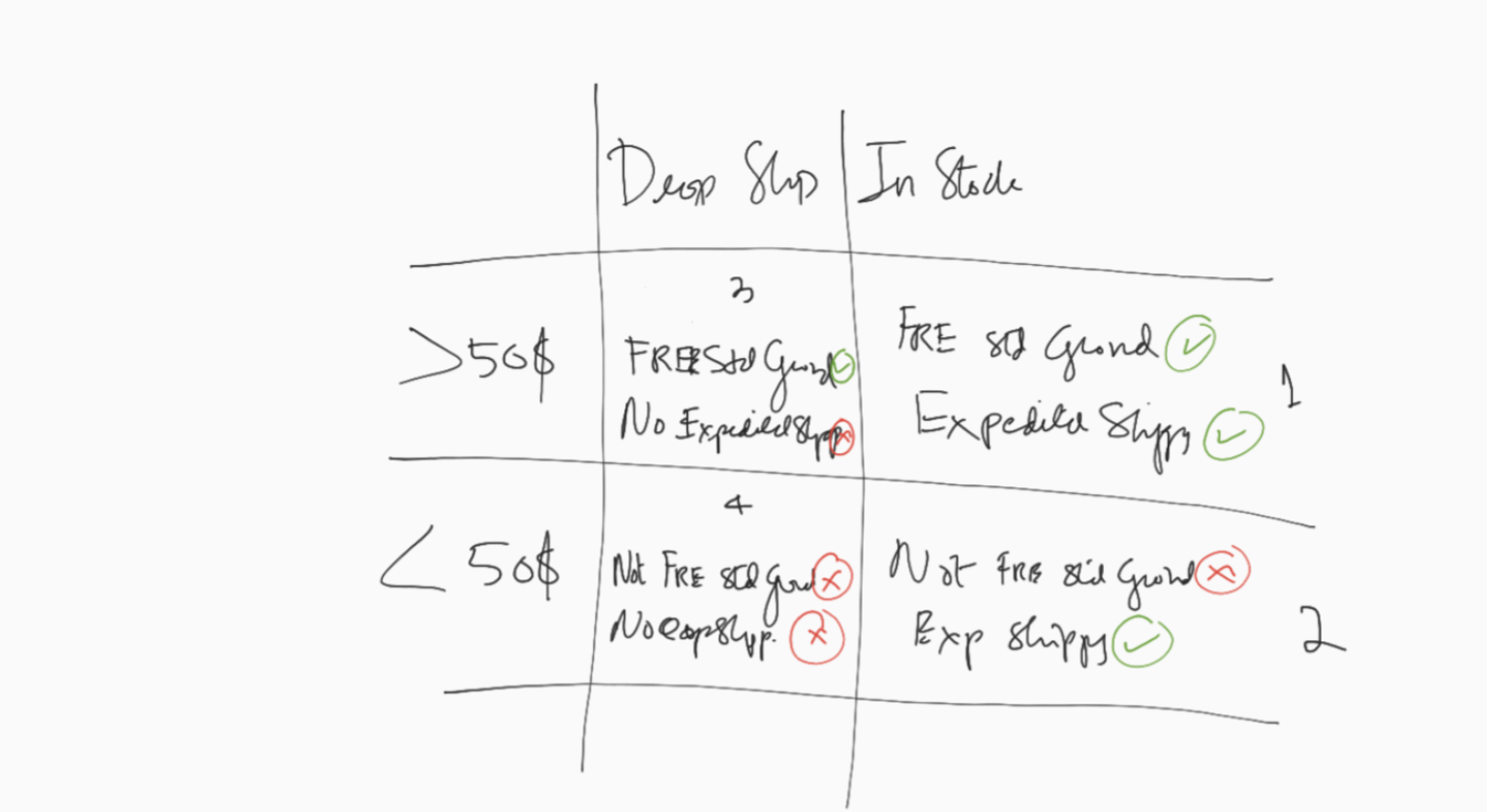
Based on my design analysis and identified opportunities, I mapped all the possible user-flows for the short term and long term concepts. For the mapping, the main categories of user flow were based on if the product item is available or free shipping / cost above $50 and if the item is In-stock or Drop-ship / expedited shipping availability. Based on these 4 categories as shown below, I mapped possible user-flows for the short term and long term solutions.

Low-fidelity Wireframes - Mobile

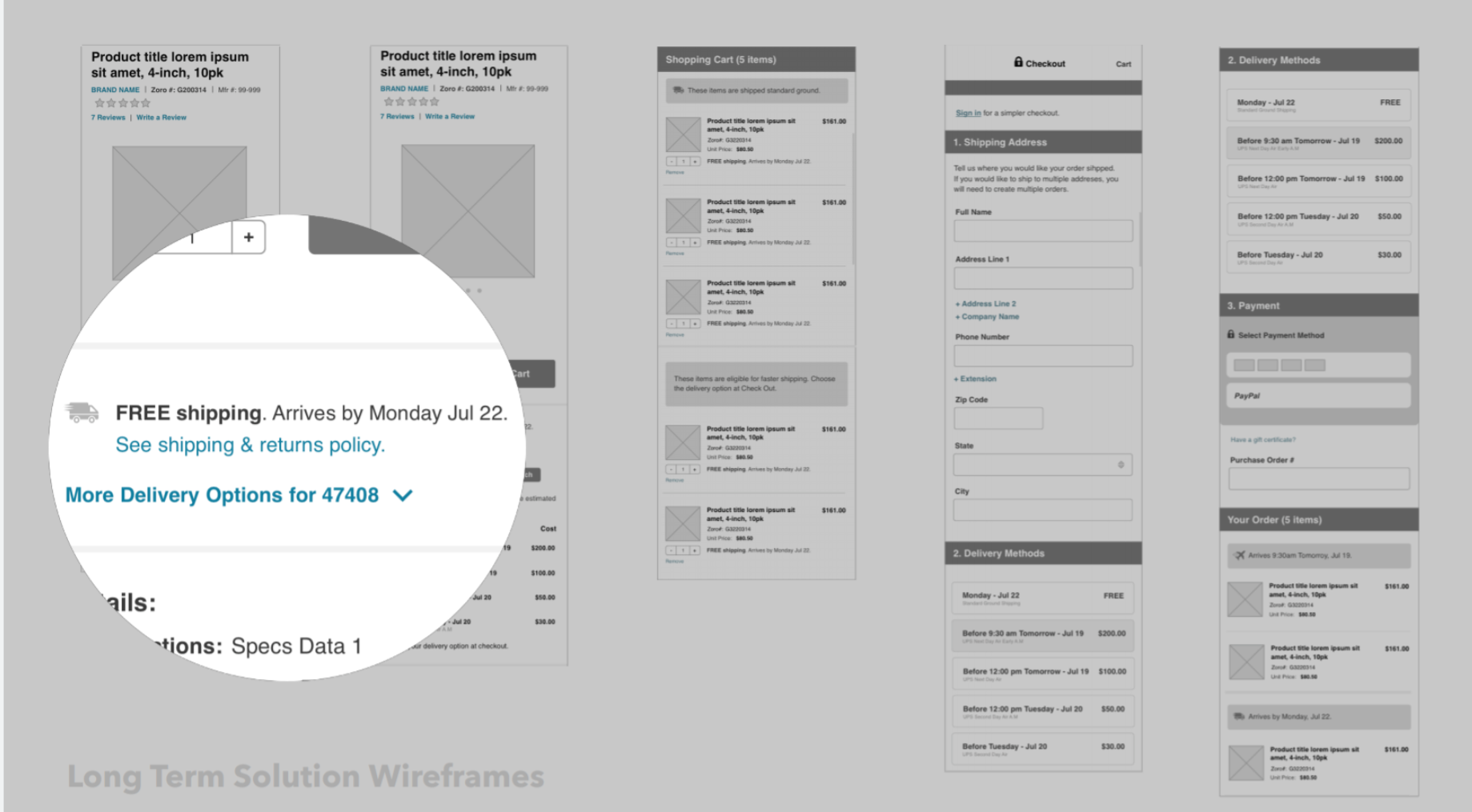
The next step was to create low-fidelity wireframes for both desktop and Mobile in sketch referring to the user-flows. Here are some of the wires I created -

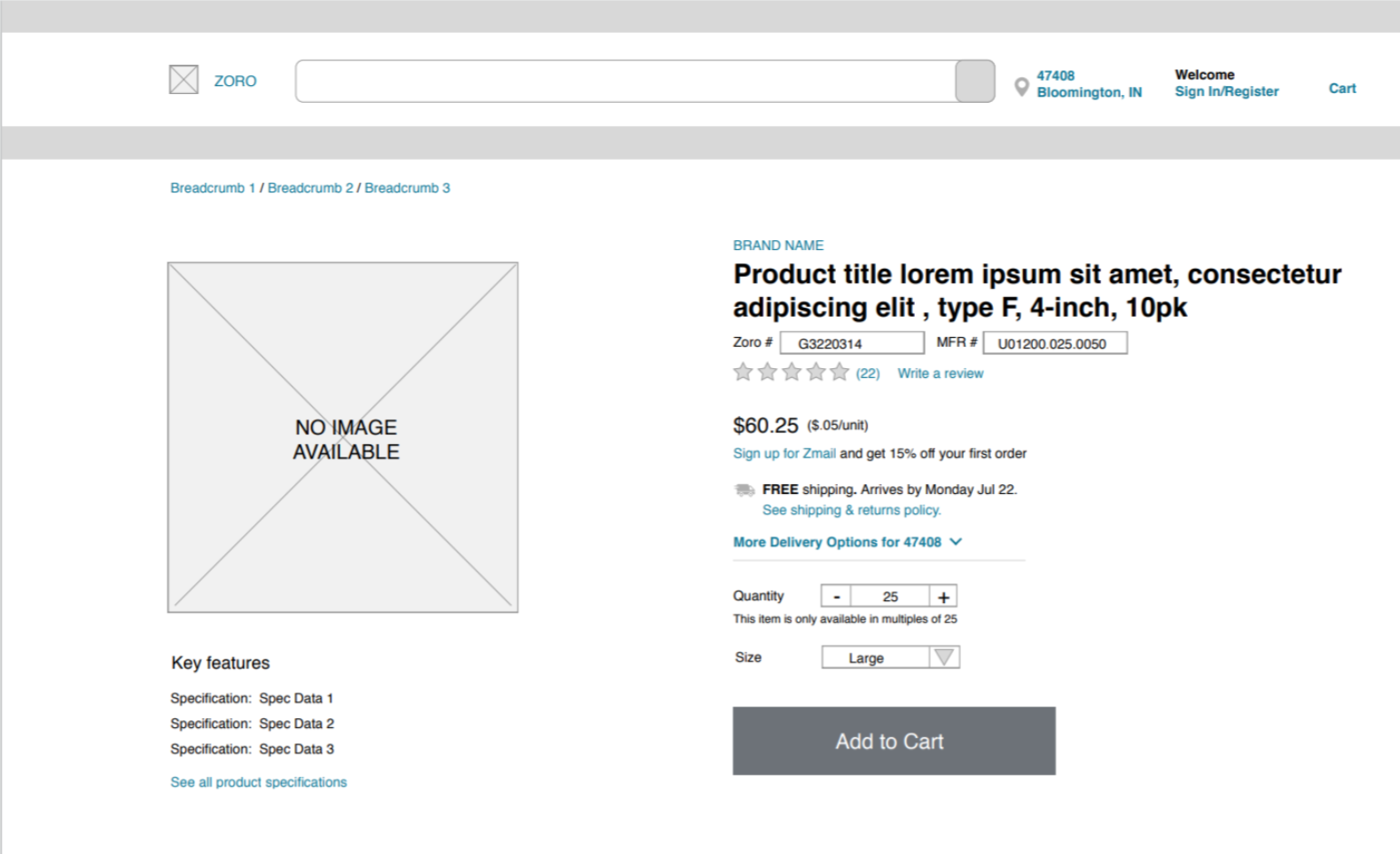
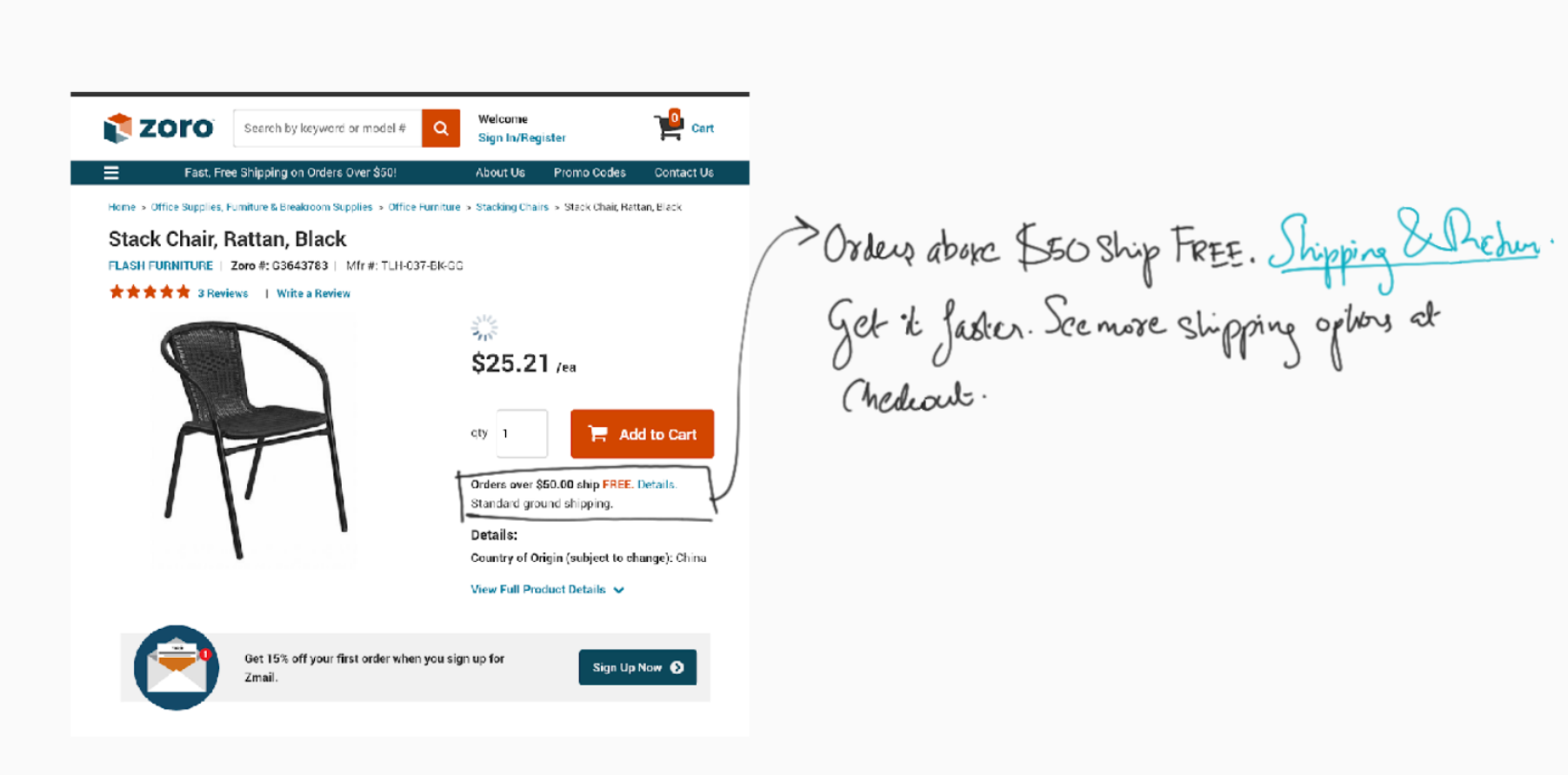
Product Details Page

This screen is the product details page and the highlighted area shows the addressed pain points of-
More noticeable shipping information and better microcopy for the delivery options and time. "See shipping and returns policy " shows Shipping and Returns information in the Product Details Page.
Availability of expedited shipping options upfront. "More delivery options for ___" indicates the possibility of Expedited Shipping and its options in Product Details Page.

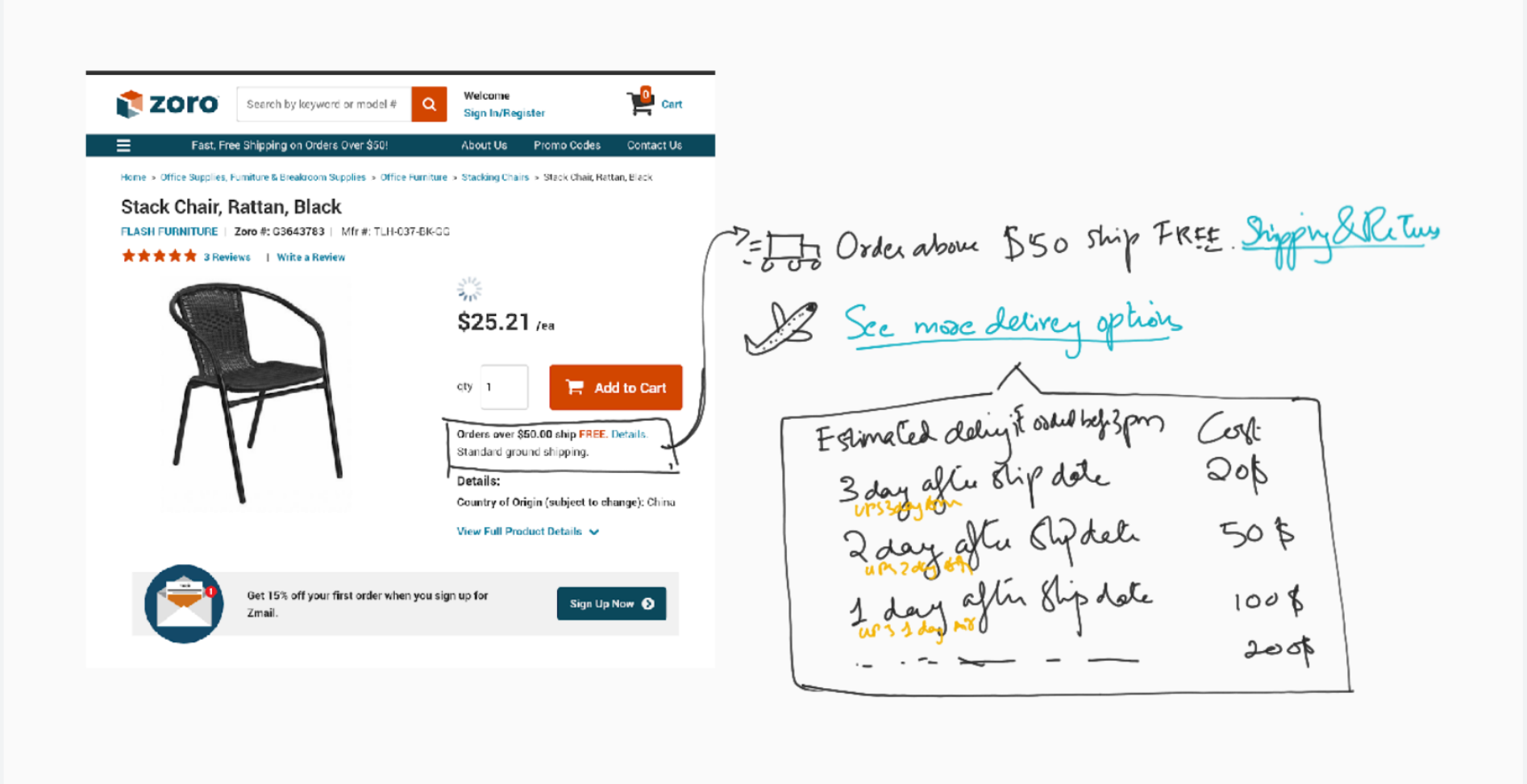
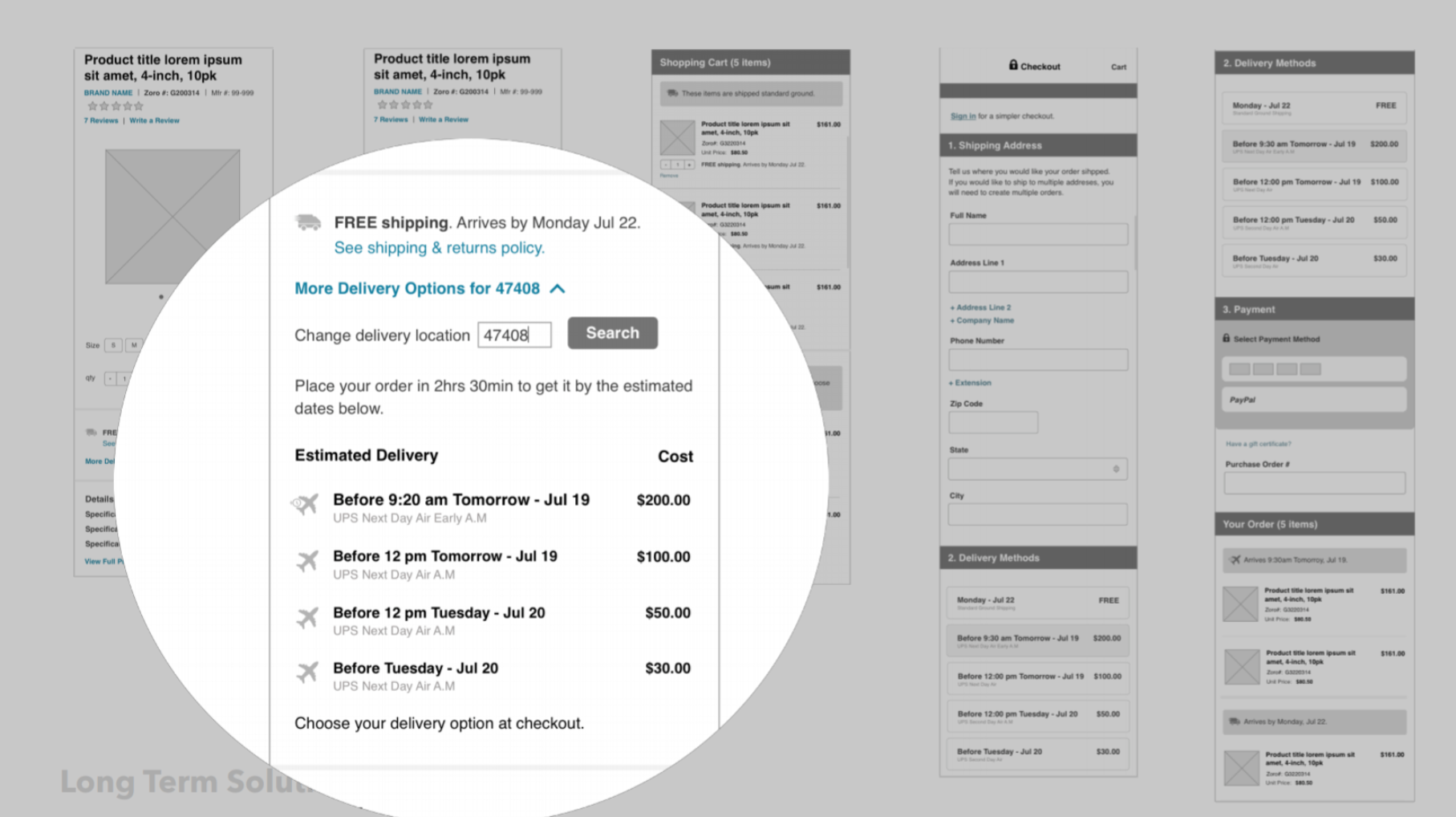
Product Details Page - Shipping Options link Expanded

This screen shows the expanded shipping options in the product details page and the highlighted area shows the addressed pain points of-
The option to change the zip-code and see the shipping options with the estimated delivery time, speed, type and cost.
"Place your order in __hrs to get it by estimated dates below" indicates cut-off time.

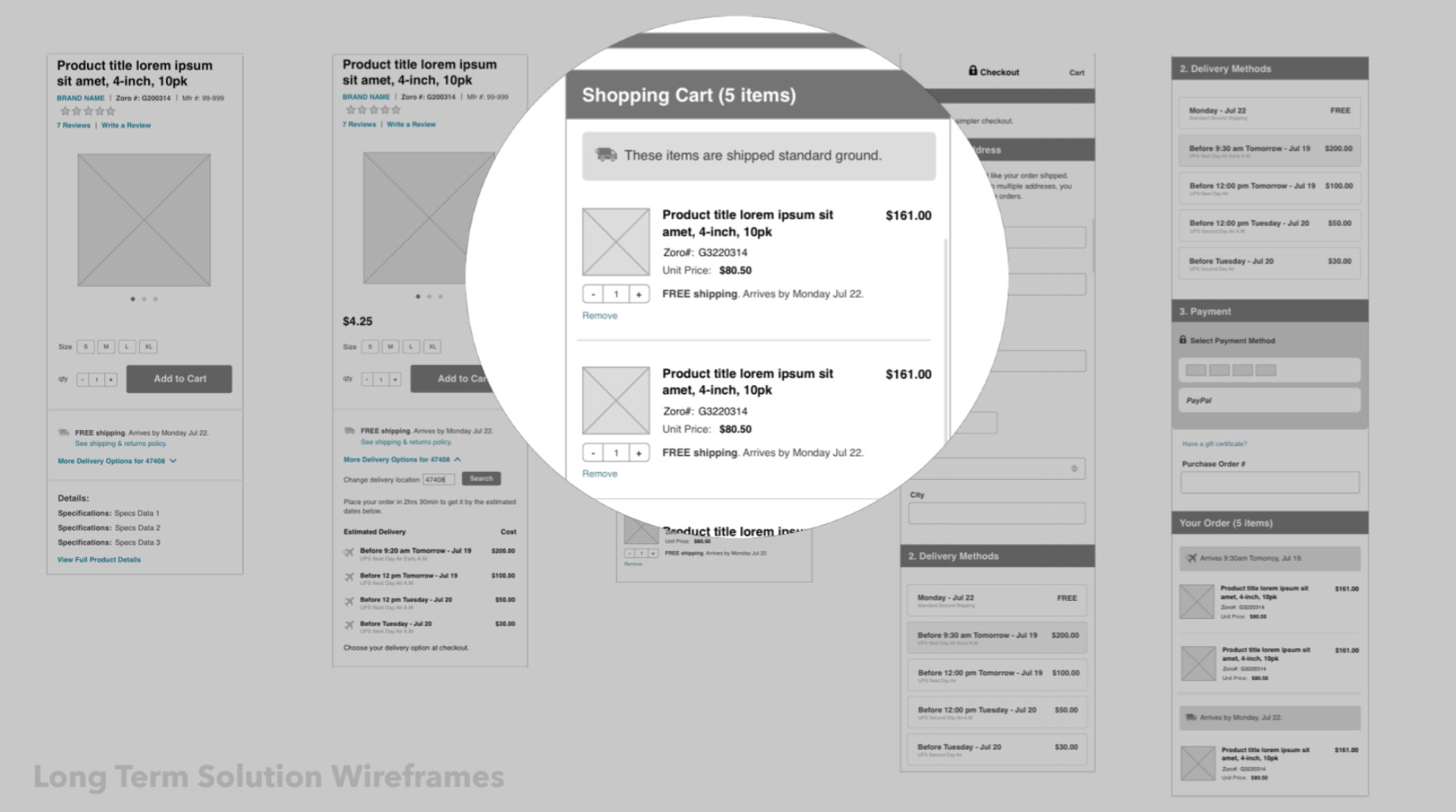
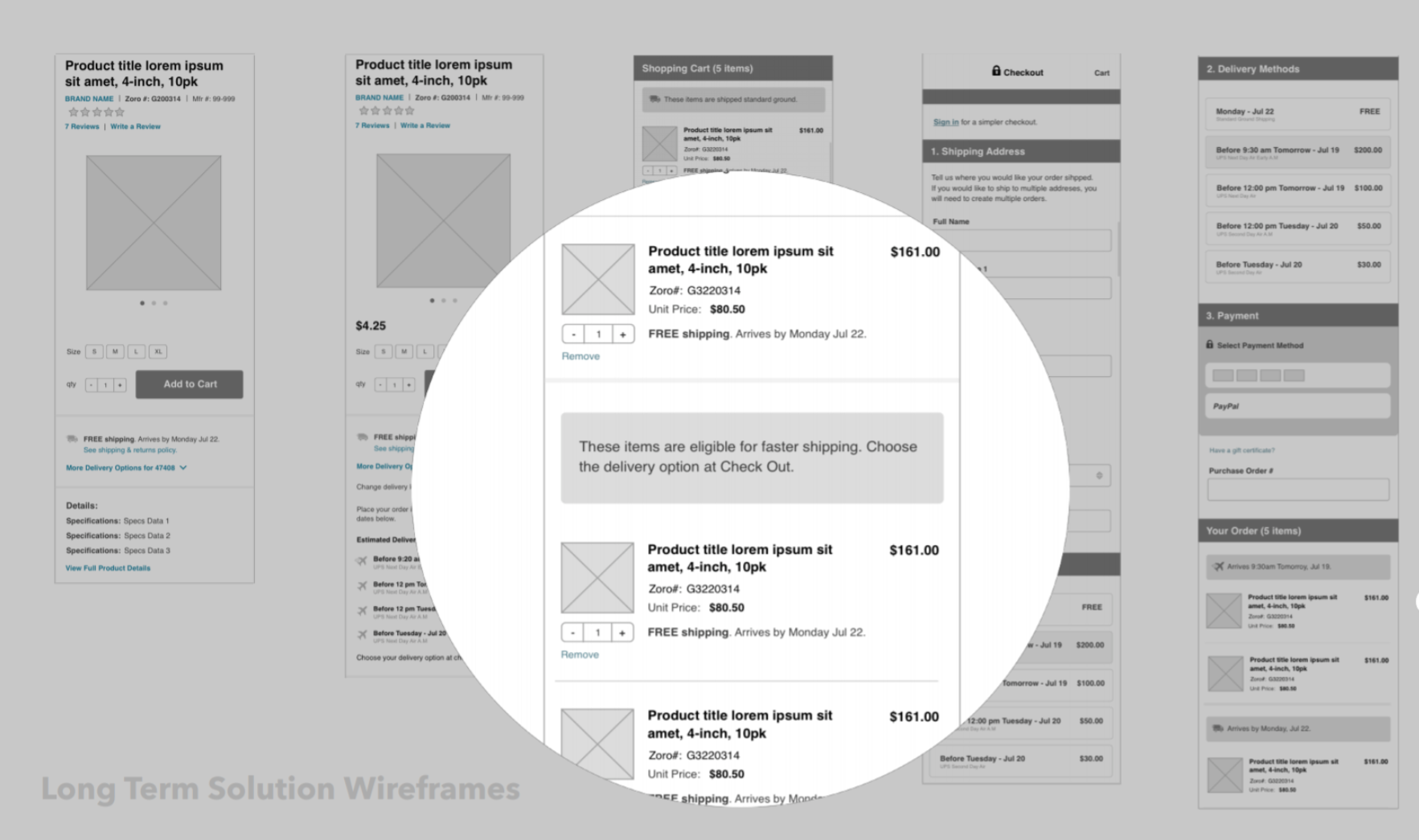
Shopping Cart - Only Standard Shipping available

Better clarity and segmenting on the items available for standard shipping and expedited shipping.
Shipping information provided in the Cart page as well.
This screen shows the cart page with selected items both "In-stock" and "Drop ship" added. The cart has multiple sections that shows the separation of items available for standard ground shipping vs expedited shipping. The highlighted area shows "drop ship" items that only ships standard ground.

Shopping Cart - Expedited Shipping availability

This screen shows the cart page with selected items added. The highlighted area shows "In stock" items that are available for both standard ground shipping and expedited shipping.

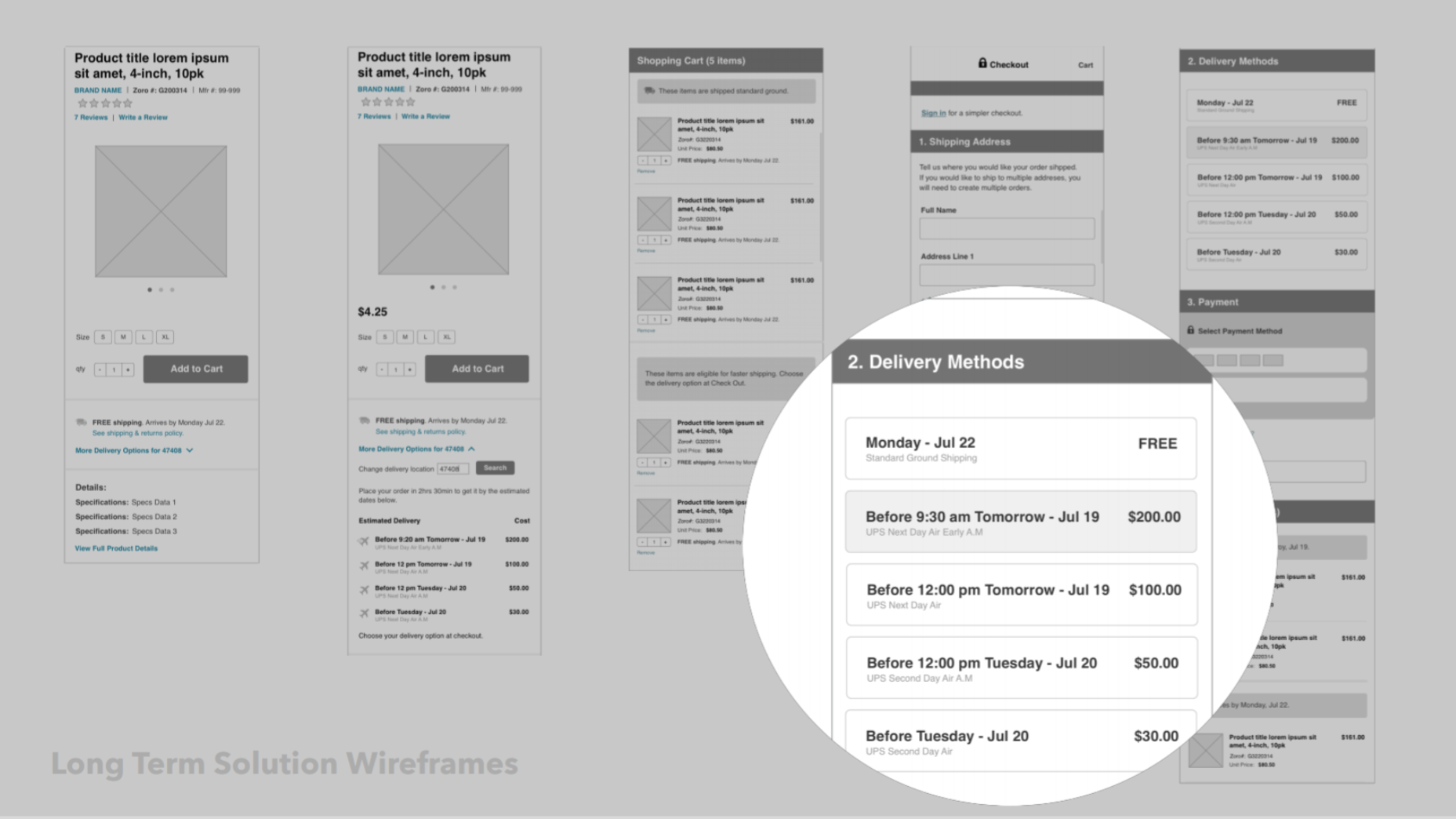
Check Out - Better Delivery options with estimated delivery time, type and cost

This screen shows the check out page with better clarity on shipping options.

What would this change?

KPI's

With the new design we are hoping to see-
1. A reduction in customer service calls and emails regarding Shipping and Delivery related queries such as delivery availability, date and type.
2. The queries regarding return policy and in-stock are also expected to reduce drastically.
3. Improved conversion and revenue for items that are eligible for expedited shipping.

Process

For this part of my project I closely collaborated with the UX Lead, UI team, Engineers in the product team and the Product Manager. The major insights were from the Clicktale analysis, A/B testing review, and Competitive Analysis of high performing e-commerce websites. My team UX Lead and I conducted a small scale Design Thinking workshop. I took forward the insights from the workshop and created a refined, robust workflow and wireframes.

Research

Clicktale Recordings and Heat maps.
A/B testing review.
Competitive Analysis.

Synthesis

Design Thinking Workshop
Affinity Mapping

Conceptualizing

Scenario Flows
Whiteboarding

Wireframing

Wireframing.
Feedback and Iteration.
High Fidelity Mockups.
Clicktale Analysis

The story of customer's behavior

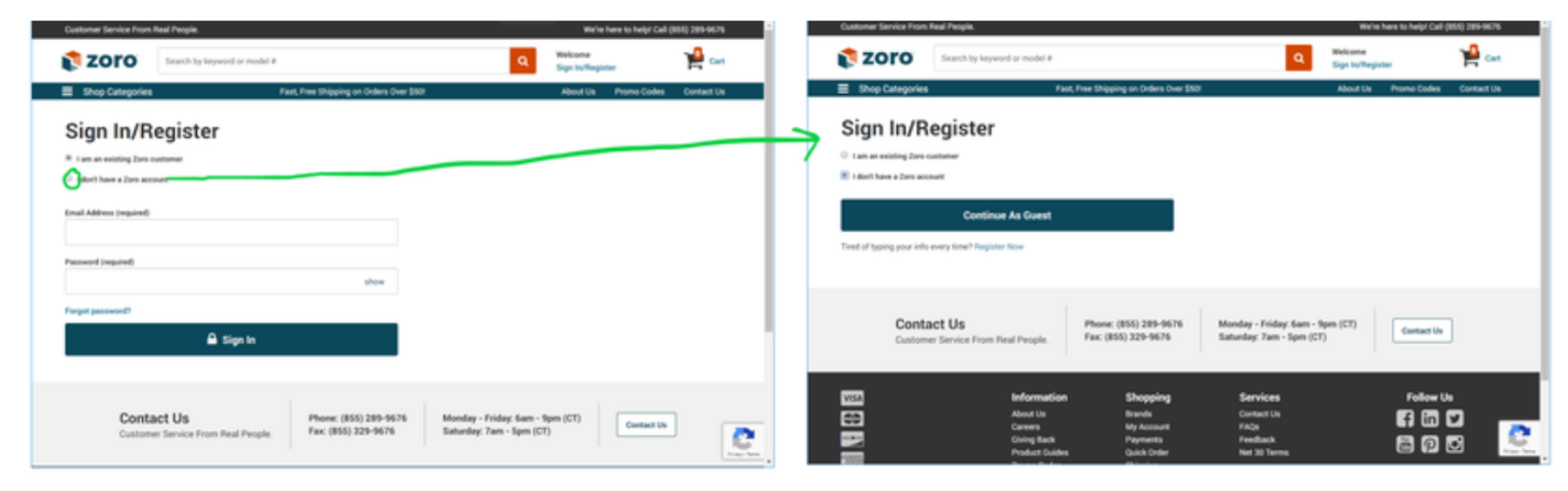
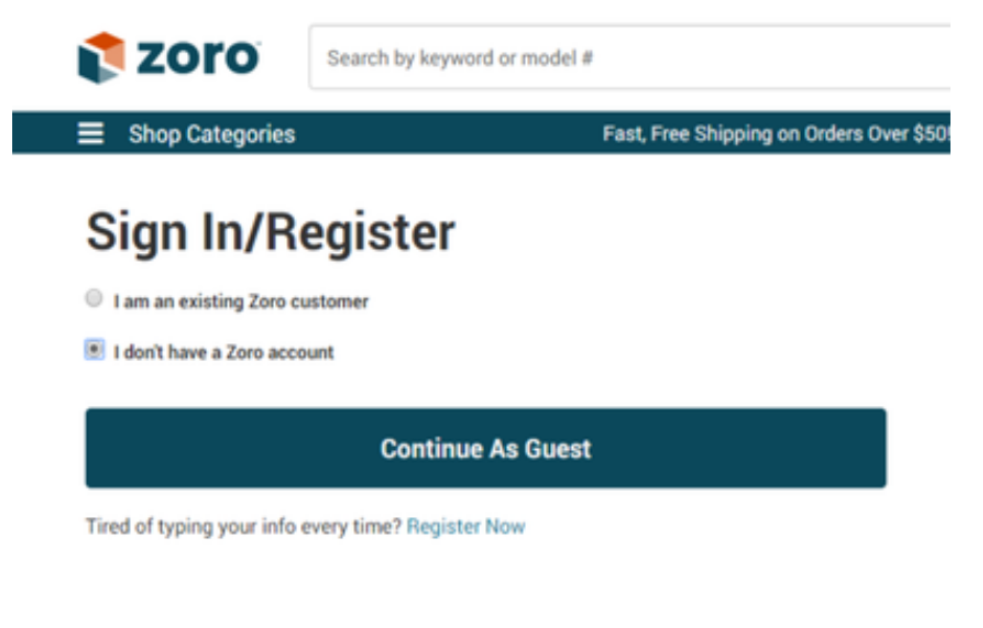
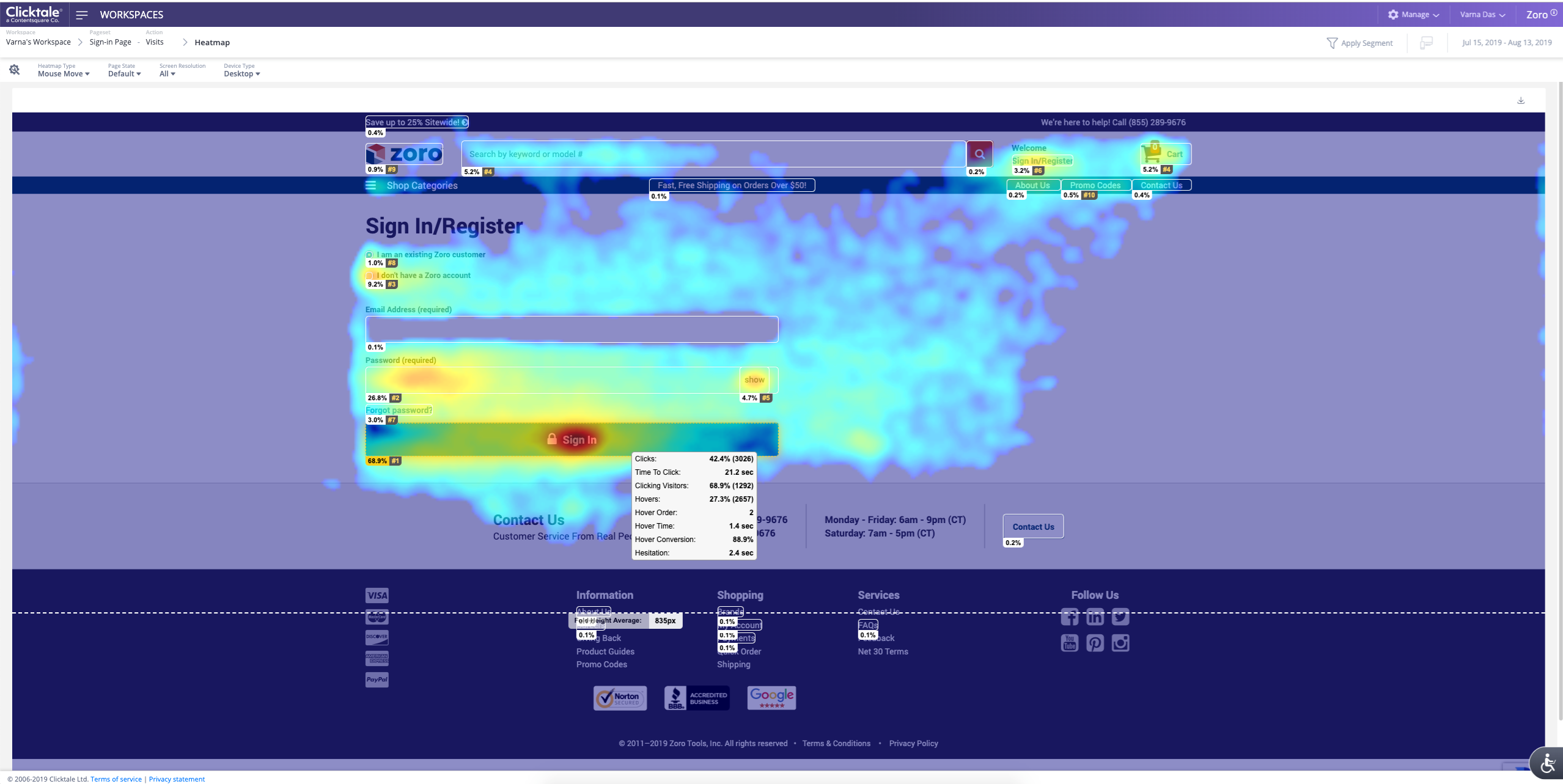
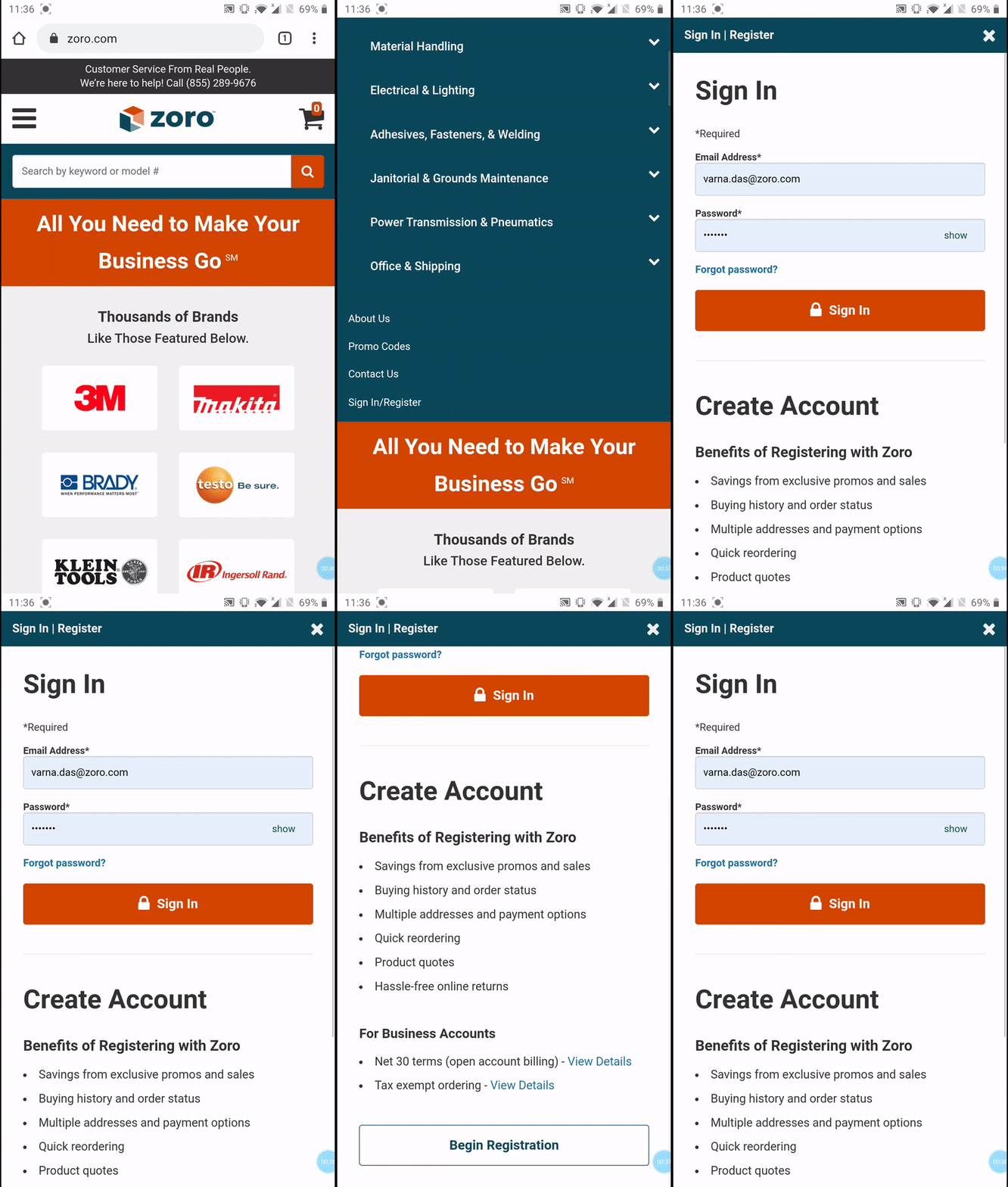
To visualize customers experience from a website perspective I went through multiple clicktale session recordings and analysed the heat-map of the Sign In/ Register page. This Sign In/ Register page consists of radio buttons to choose authenticated vs guest login.

I learned that with respect to login, unlike the usual the check out abandonment due to forced account creation, Zoro do not force account creation which is great. But, we are making it needlessly difficult for customers to locate the guest check out option. There is a lot of potential here to make the customers lives better.

Sign In/ Register Page for Logging in or Continuing As Guest
Heat-map of the Sign In/Register Page

Takeaways :

01. Majority of the customers do not prefer to create an account to purchase items.

02. The guest check out option is not the default option and is in fact hidden.

03. The Sign In/ Register step is intrusive in their check out experience.

Learn and Practice Design Thinking

Design Thinking Workshop

We conducted design thinking workshop as a part of our next step to spark innovation, encourage user centered thinking, align teams understanding in different product areas. We selected participants from multiple functions such as Quality Assurance, Marketing, UX, Product Management, etc to ensure that we will have a wide array of perspectives and investigate the situation from all angles. Our four step model workshop consisted of-

01. Clarify the Challenge

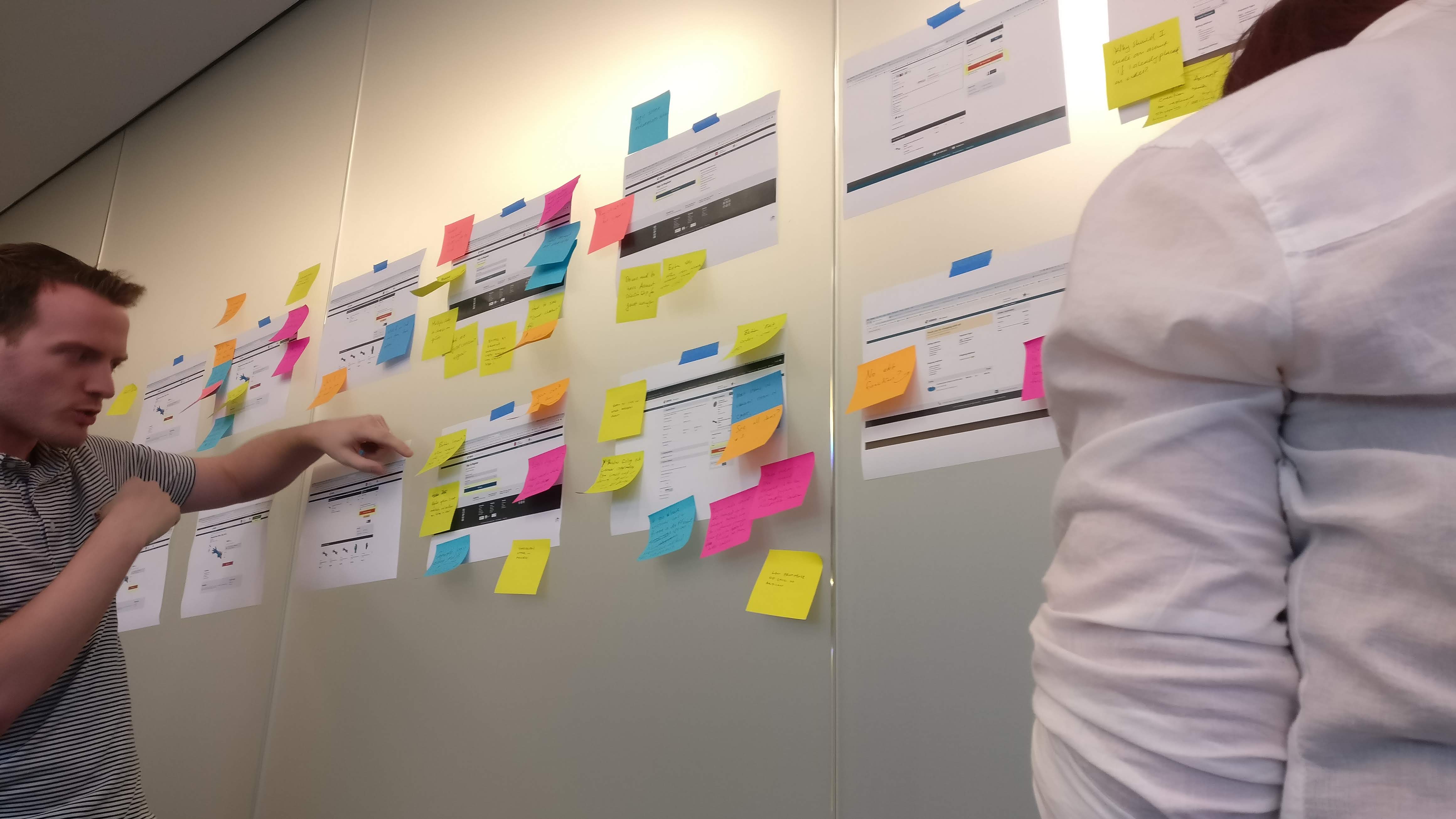
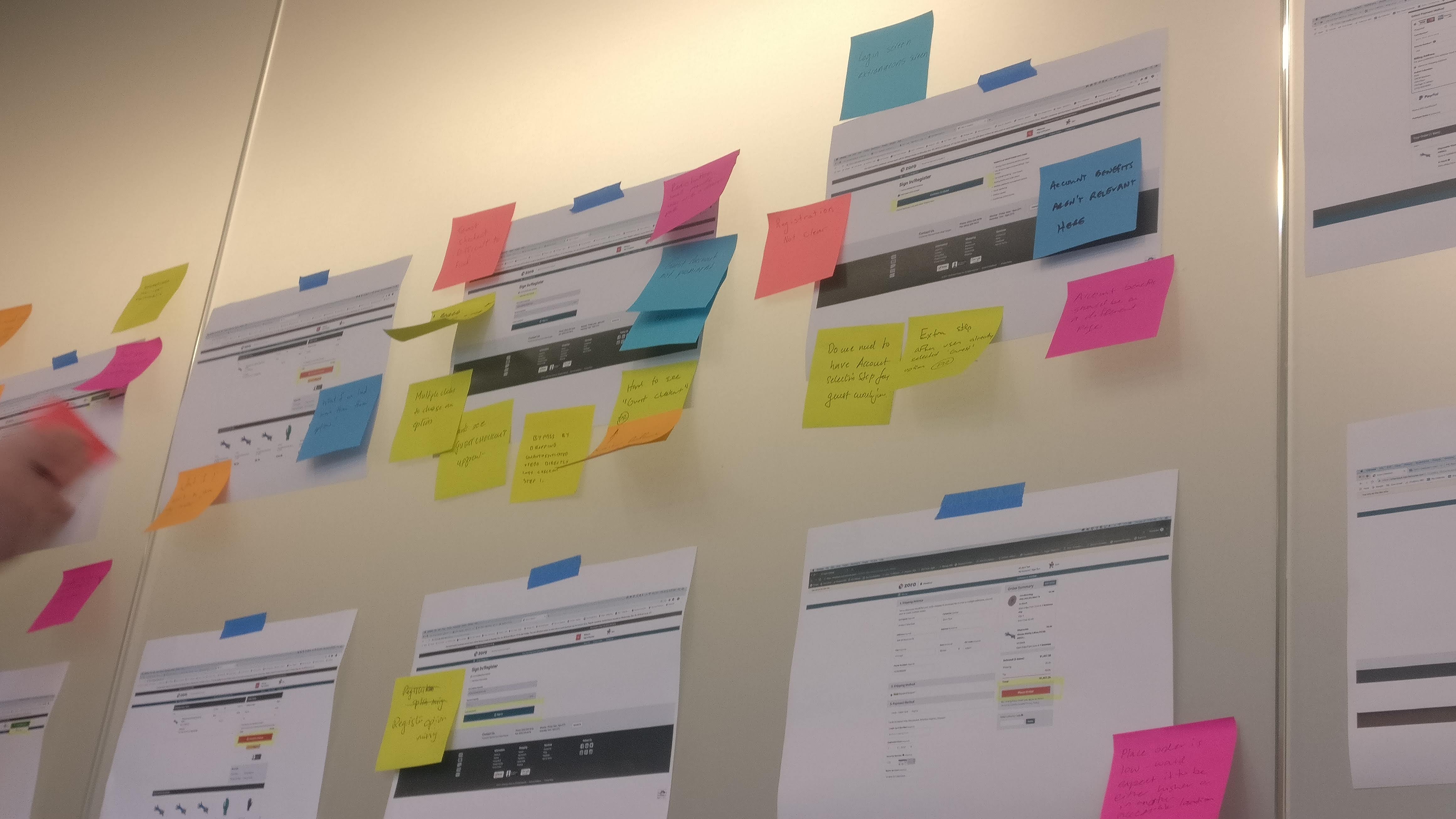
First on the agenda was discussing about the problematic situation. We printed the current end to end Add to Cart workflows, provided background information, key data and challenges.

We walked around marking each of the sheets with post-its pinpointing what each of us think the challenges or issues are.

02. Identify the pain-points

We identified the main pain-points within the guest and authenticated check out workflows and defined open ended problem statements-

1. Difficult to get to cart from Product page
2. Guest login option is hard to find
3. Unclear login options within Signin/Register
4. Cart merging when logged in

We identified the main pain-points within the guest and authenticated check out workflows and defined open ended problem statements-

How might we make Cart more accessible?
How might we reduce the clicks to Check Out?
How might we integrate login experience to check out?
How might we make it easier for customers to login?How might we make Login flow least disruptive?

03. Ideation

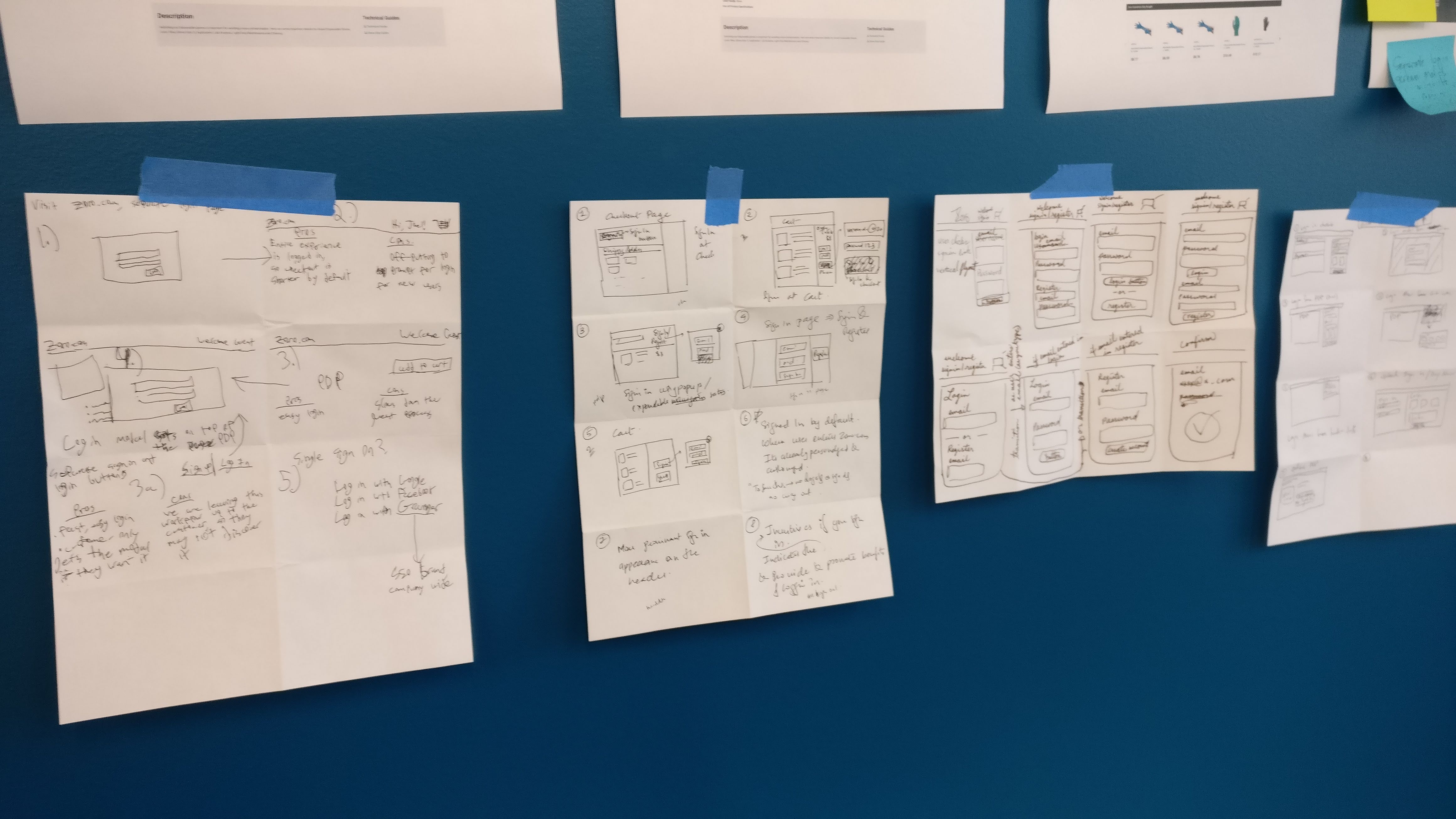
We divided the questions and split up into teams and started ideation. Within our teams, we generated crazy 8’s to consider all the possible solutions we could think of. Next, we went through each of our ideas and build on each others, modify and create the best actionable solutions. Both the teams came together and presented the concepts.

04. Ideas to refined solution

I took the insights from the workshop and created a more refined and robust design solution and workflow with the support from my clicktale analysis and other research.

Synthesis and Scenario Flows

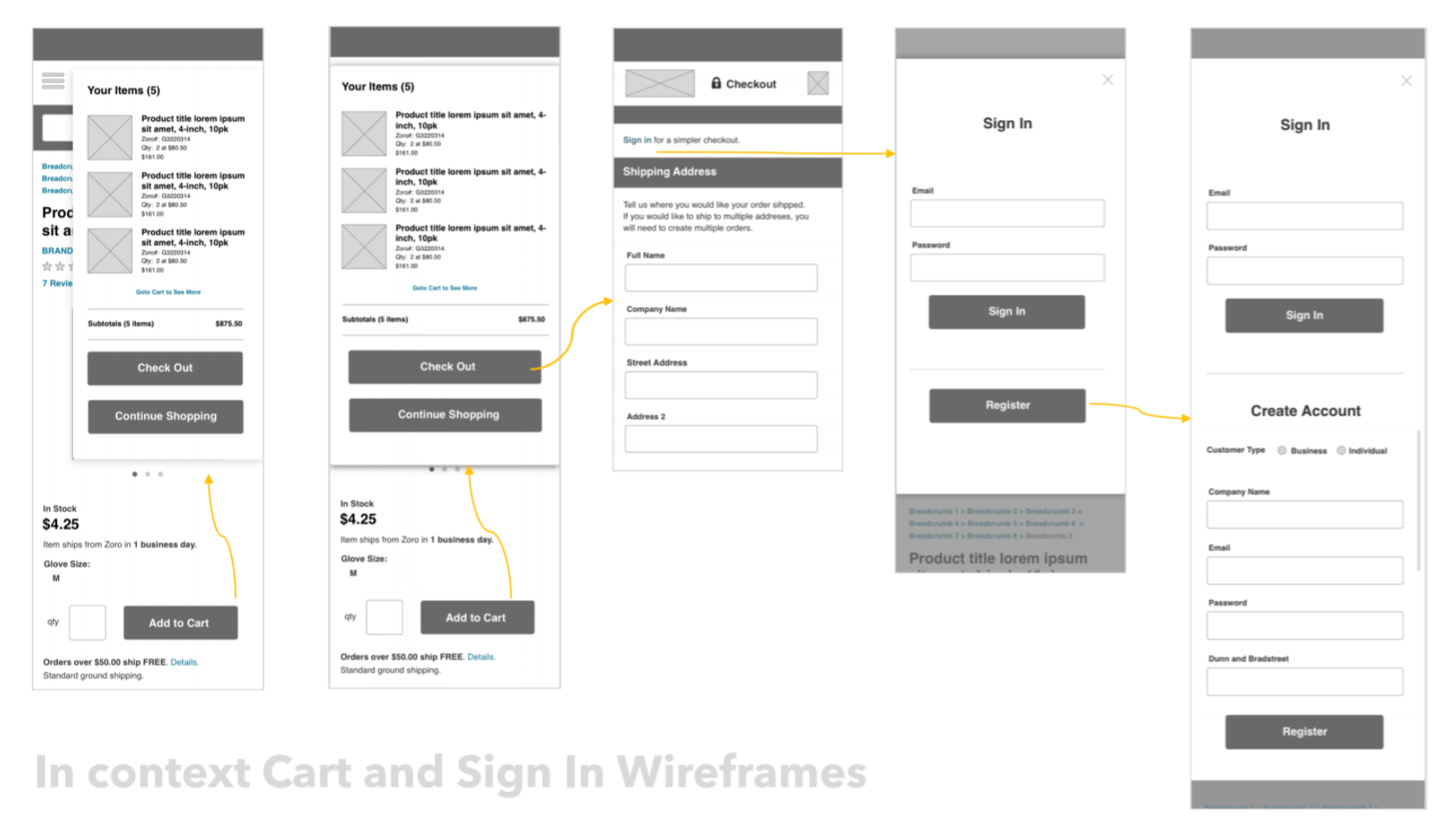
Redesigning Add to Cart Interaction and the subsequent Check Out Experience

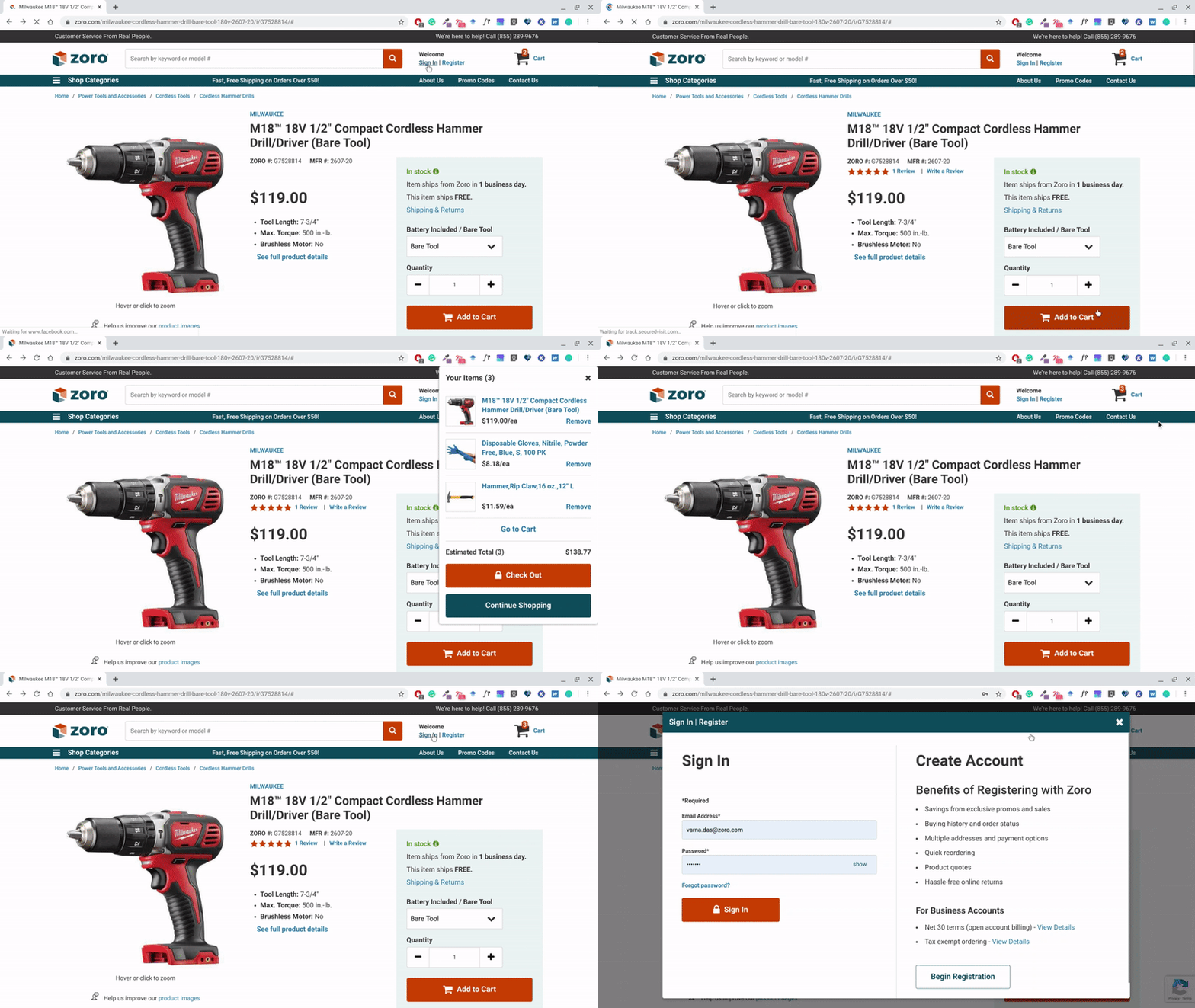
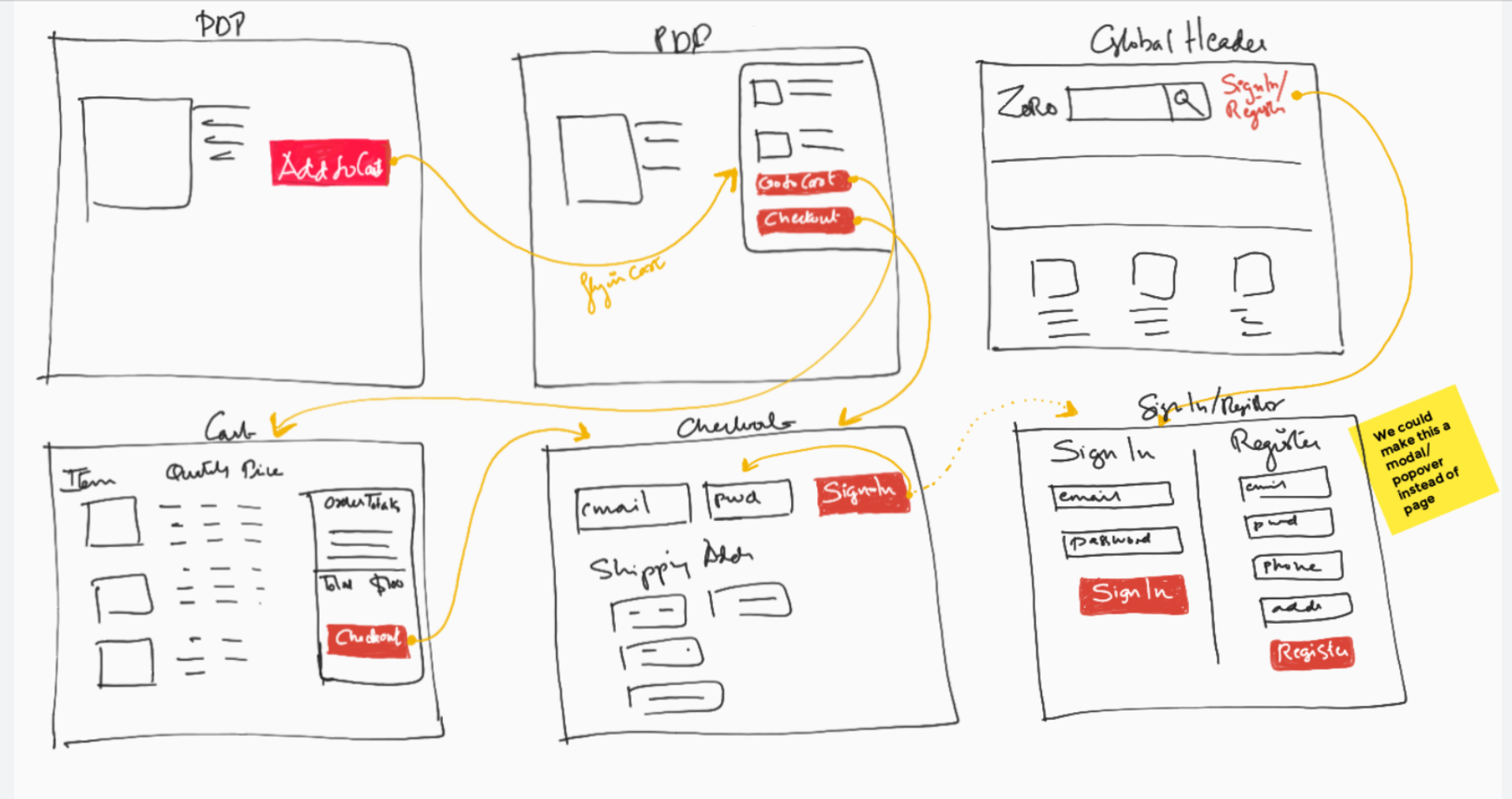
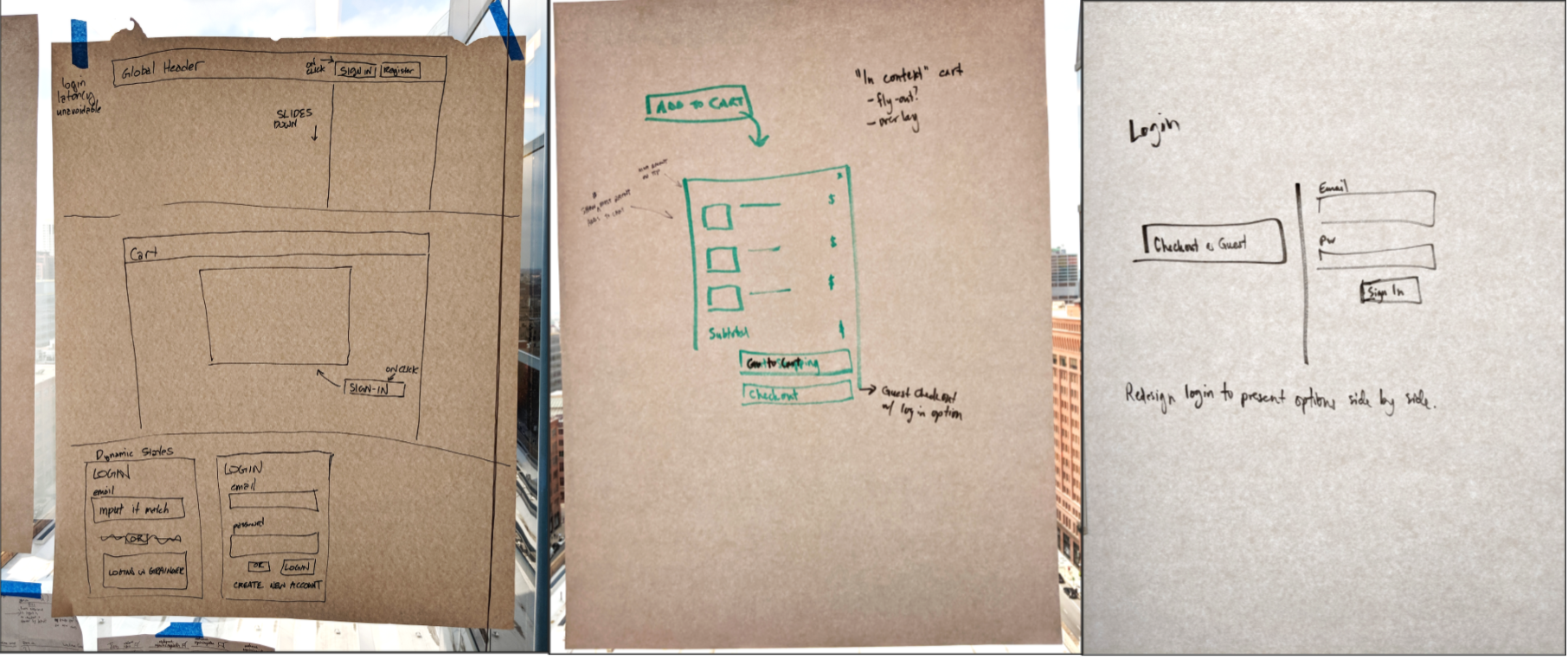
Based on the research, analysis and design thinking workshop, I mapped out the workflow that would accomplish the goals of an efficient, easy and more integrated Add to cart, Check Out and a non-intrusive Sign-In experience from the Product Details Page (PDP) to Check Out.

Fly out mini cart with 3 latest items, 2 call to actions to go to Cart and go directly to Check Out.

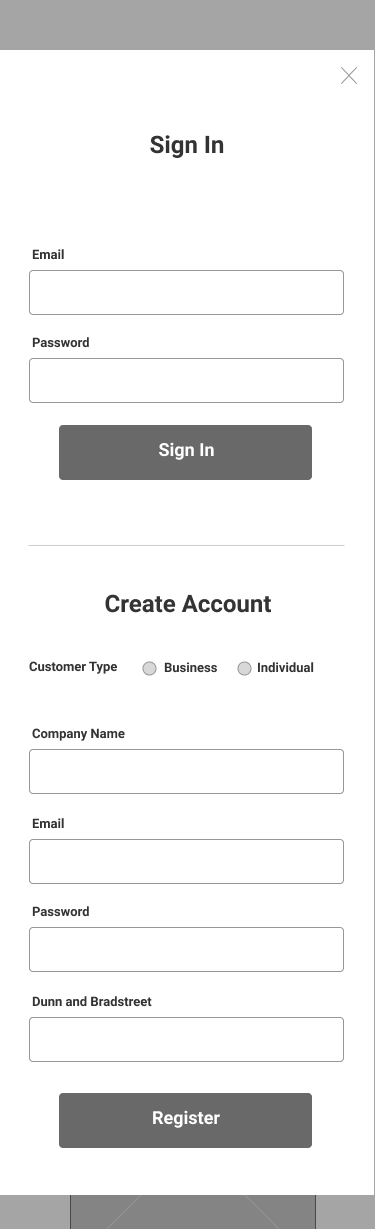
New Sign In/ Register modal on global header- a non-intrusive, integrated login.

By default, the customer is a guest and have a choice to a simpler Check Out process by signing in.

Concept


Fly out mini cart
with 3 latest items added and 2 call to actions to go to Cart and go directly to Check Out.

New Sign In/ Register modal on top of the existing page which ensures a non-intrusive, integrated login to the customers account to proceed to Check Out.

By default, the customer is a guest and they have a choice to have a simpler Check Out process by signing in or continue as a guest.

Low Fidelity Wireframes

Add to Cart

Fly-out Cart

Check Out

Sign In/ Register

Sign In Modal

Register

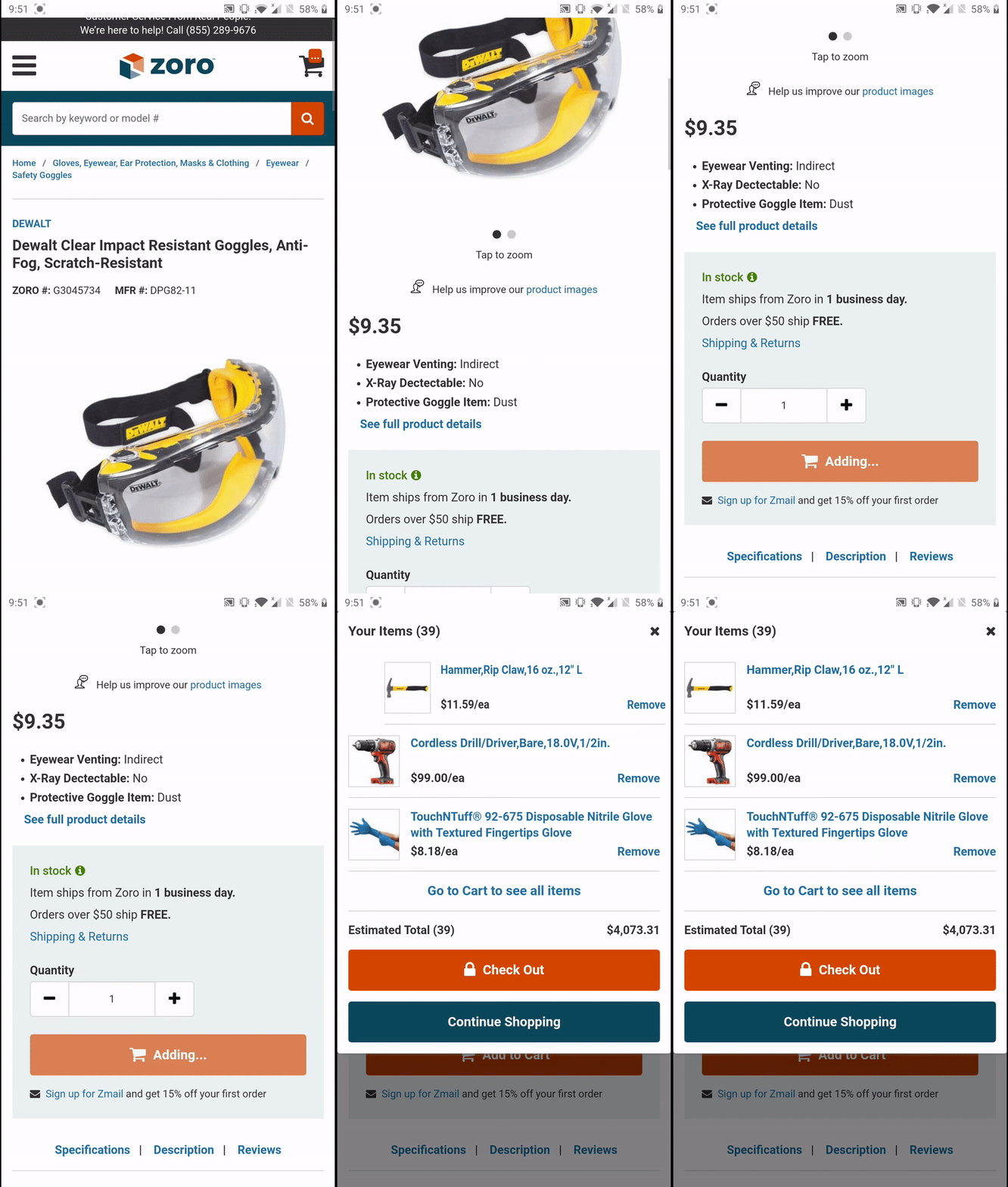
Live Design

Click here to see site. Click Add to Cart and Sign-In to see the implemented wireframes. Preview shown below-

Adding items to cart from Product Page, makes the fly out cart to emerge.

Three calls to action from the fly out cart to continue shopping, goto cart and check out.
Easily accessible cart from product page.
Better access to check out.
Guest check out by default.

See live version here by clicking on Add to Cart and Sign In/Register

KPI's

What would this change?

With the new design we are hoping to see-
1. A reduction in drop outs at the Login step of Check Out.
2. Improved customer satisfaction as they progress through the Check Out funnel.
3. More Check Out conversions.

Usability Study- Alexa Integration with Zoro

For my third project, I collaborated with the software engineering interns who were working on a very exciting project of integrating Zoro.com with Alexa. After the first iteration of development, we wanted to study the users shopping behavior of using the developed Alexa voice commands by observing them in action and understand how they perform the tasks and achieve the intended goals.

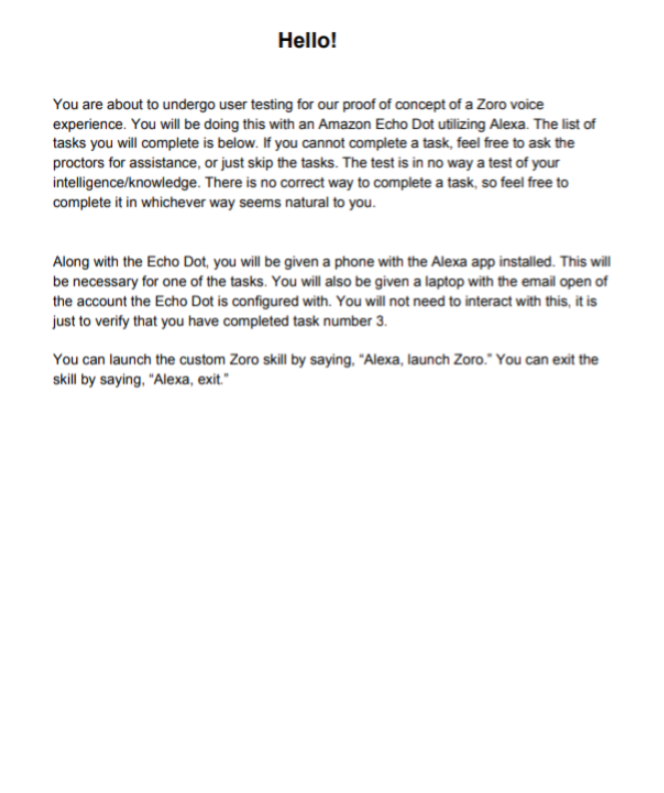
We conducted moderated task completion test with Zoro.com employees as potential customers. We selected employees of Zoro.com since they have a working knowledge of the product, an interest in using voice interfaces, display diverse online shopping behavior and limitations with resources and time for the completion of the project. As a result we identified ways to make the product more functional, usable and desirable.

For this prototype/ concept testing, video and audio recordings were collected on all the interviews for the purposes of data analysis. We conducted a pre and post survey. Individuals participating in the test was asked to perform a set of tasks and interact with the prototype through voice commands and we asked them to think out loud about their thoughts, feelings and expectations. The test for each participant lasted for about 30 min.

Study Goals

1. To test Alexa integration with Zoro.com for users to search for items, receive the search results via email, and select items through voice commands.
2. To identify if users are able to understand the responses from Alexa.
3. To identify if the users are clear about what voice commands they should input next.
4. To identify the learn-ability of using Zoro.com through Alexa.
5. To identify usability issues with the responses in the form of voice, email or text.
6. To identify sources of errors.
7. To identify what functionality and response the user expects from a vocal experience of using Zoro.com
8. To measure if users are able to complete what they intend to do.
9. To measure the ease of use of using voice interface for shopping in Zoro.com. 
Process

Planning

Usability Study

Analysis

Reiteration

The existing code and commands are modified based on the insights
We thoroughly analysed the data we collected and discovered insights.
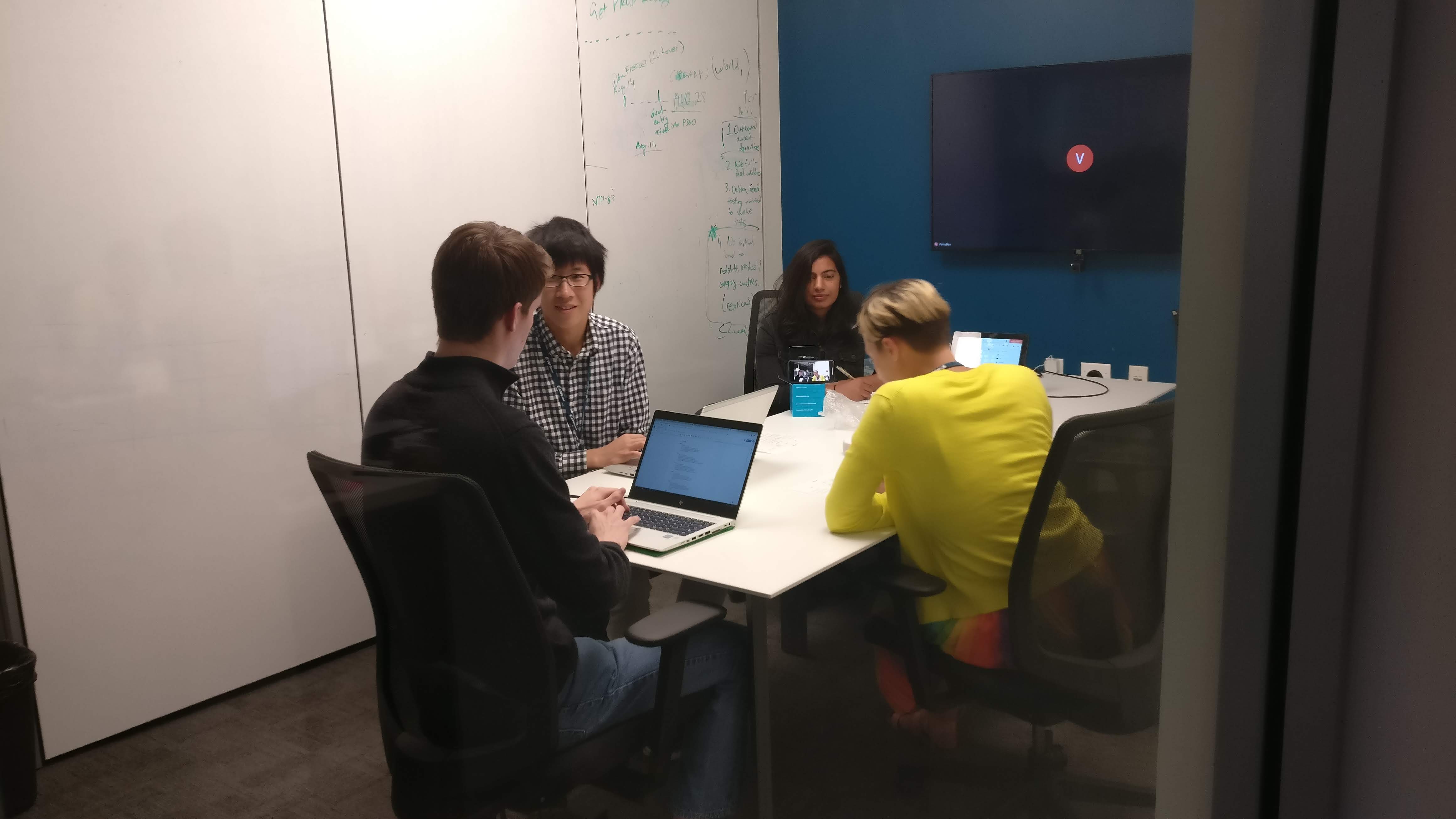
In this phase, we conducted surveys and executed the usability study of 11 participants through the span of 2 days.
We planned the logistics and execution of the usability test.
Recruitment of Participants

We chose 11 participants from Zoro that matched our requirements based on even distribution of age group and expertise in using voice interfaces. We planned to execute this on a span of two days in two Zoro locations.

Pre survey

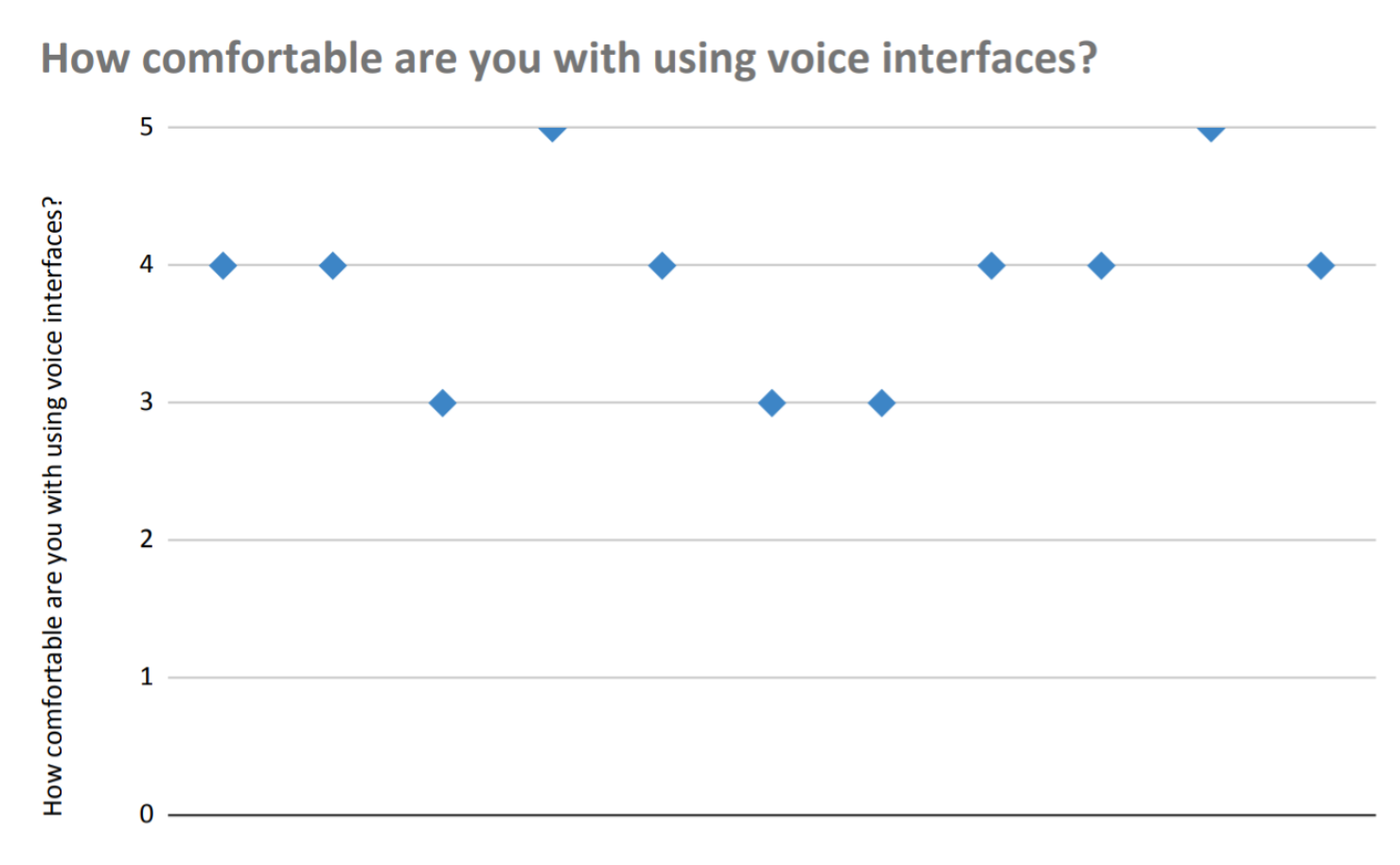
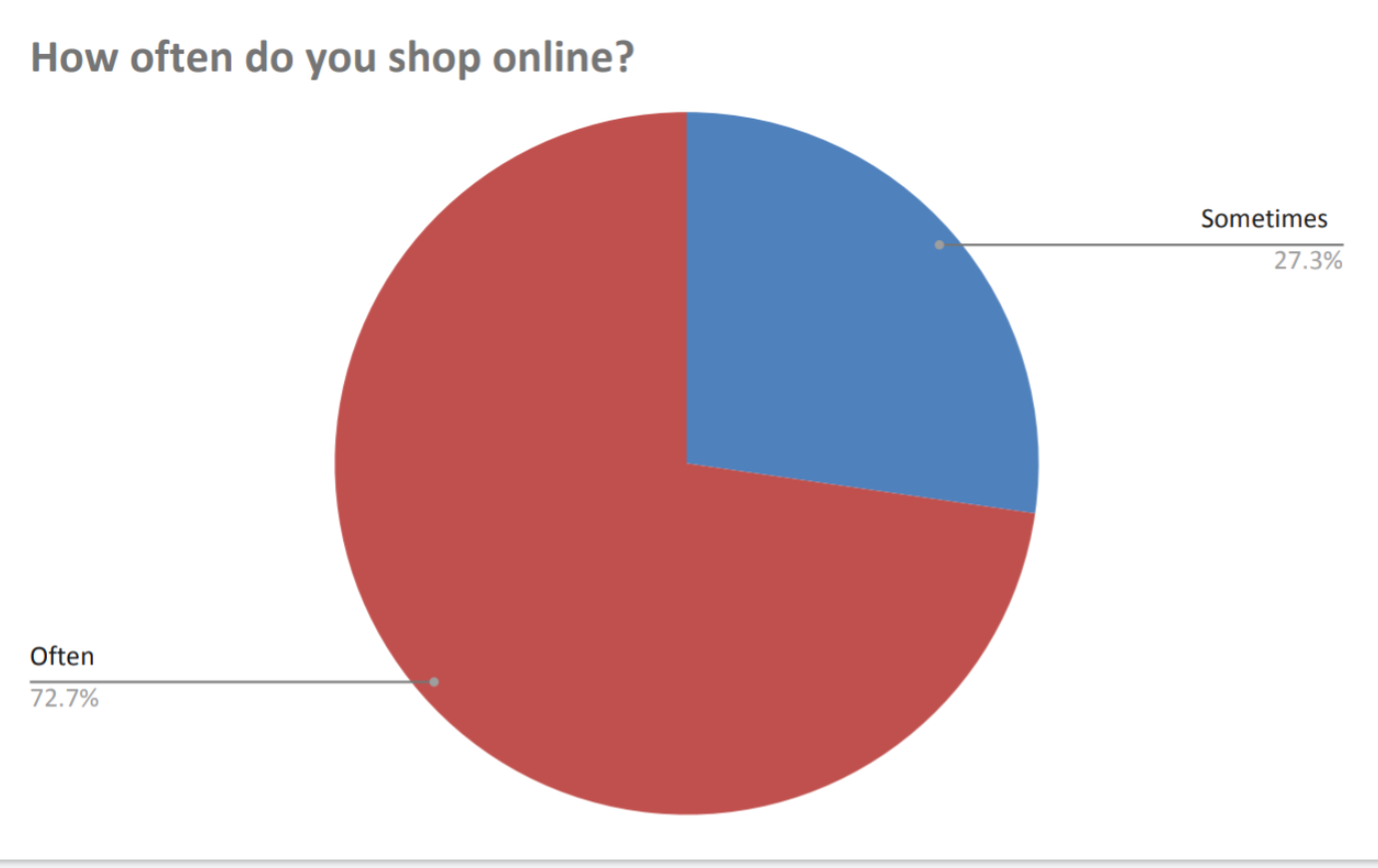
The pre-survey was to understand participants comfort level in using voice interfaces and what their main contexts and purposes of ordinary usage are. We also tried to get insights on their past online shopping experiences.

Execution of the usability study

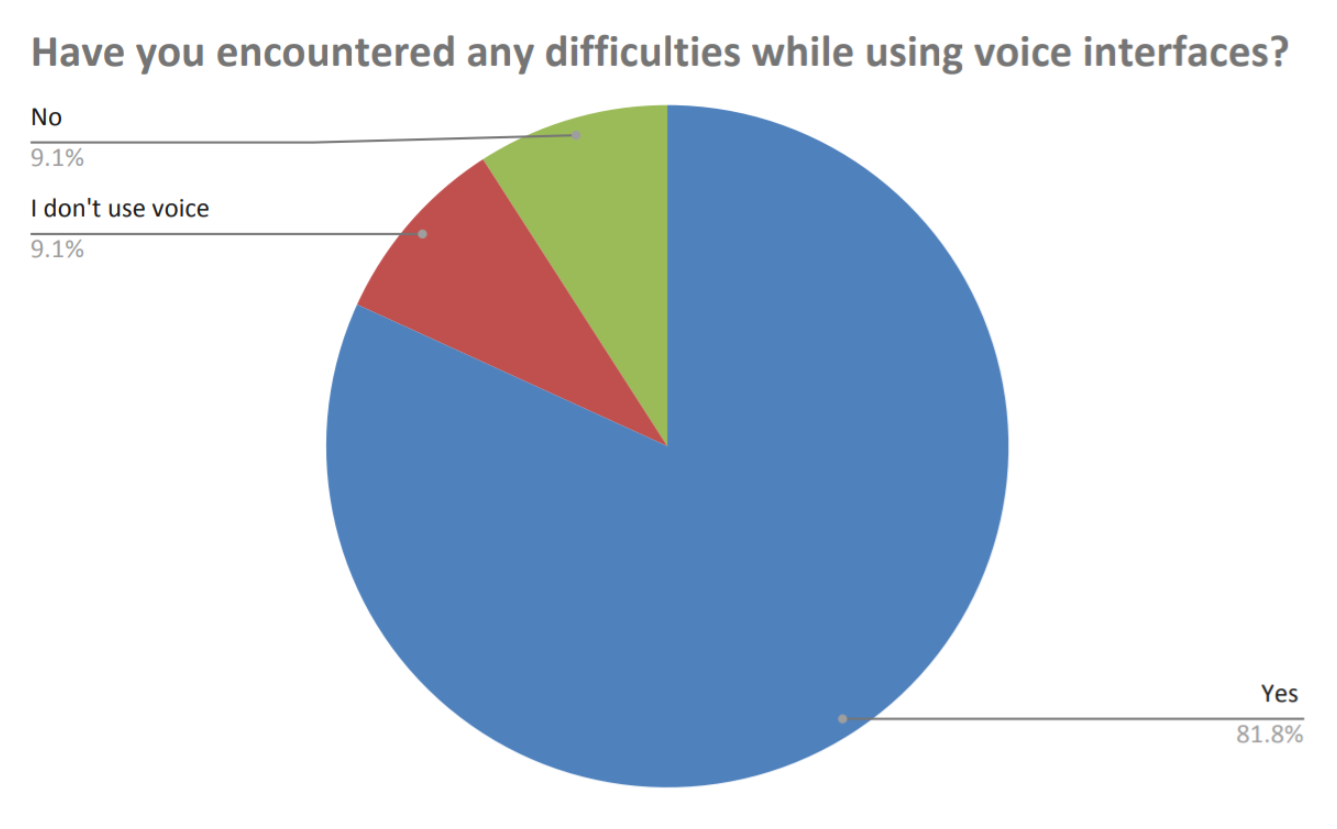
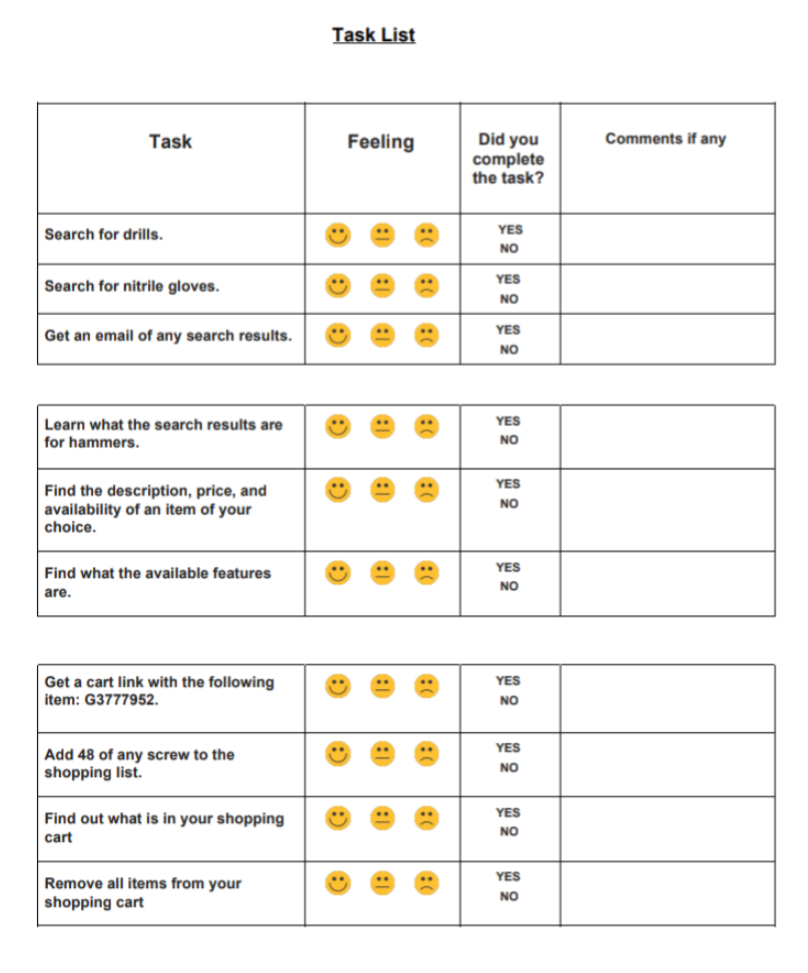
We provided a list of selected tasks for the participants to perform using Amazon Echo Dot. All the tasks were created for specific inquiry of a function that Zoro performs. We identified the functions and broke down the high-level tasks to sub-tasks for which we created a task sheet consisting of the task, the emotion the participant experiences, the feeling of completion and comments if any.

We took notes on our observation for each participant and compared against the completed sheet. After completion we interviewed them briefly about their experience and to gather feedback.

We measured the responses with the metrics -
1. How confident a user is with interacting through the voice interface 
2. How easily a user can interact through the voice interface 
3. Satisfaction level when interacting through the voice interface 
4. The number of times the user has to repeat the voice command 
5. The number of times Alexa gives an unexpected response 
6. The amount of time it takes the participant to complete the task 
7. Successful task completion 
8. Critical errors that stop the participant from test completion. 
9. Indirect completion of tasks. 

Desirable Outcomes 
1. A user says the correct utterances to invoke specific intents.
2. A user is able to complete all tasks successfully.
3. A user is able to identify when a task is completed. 
4. A user is satisfied with the tasks they are performing.

Post survey

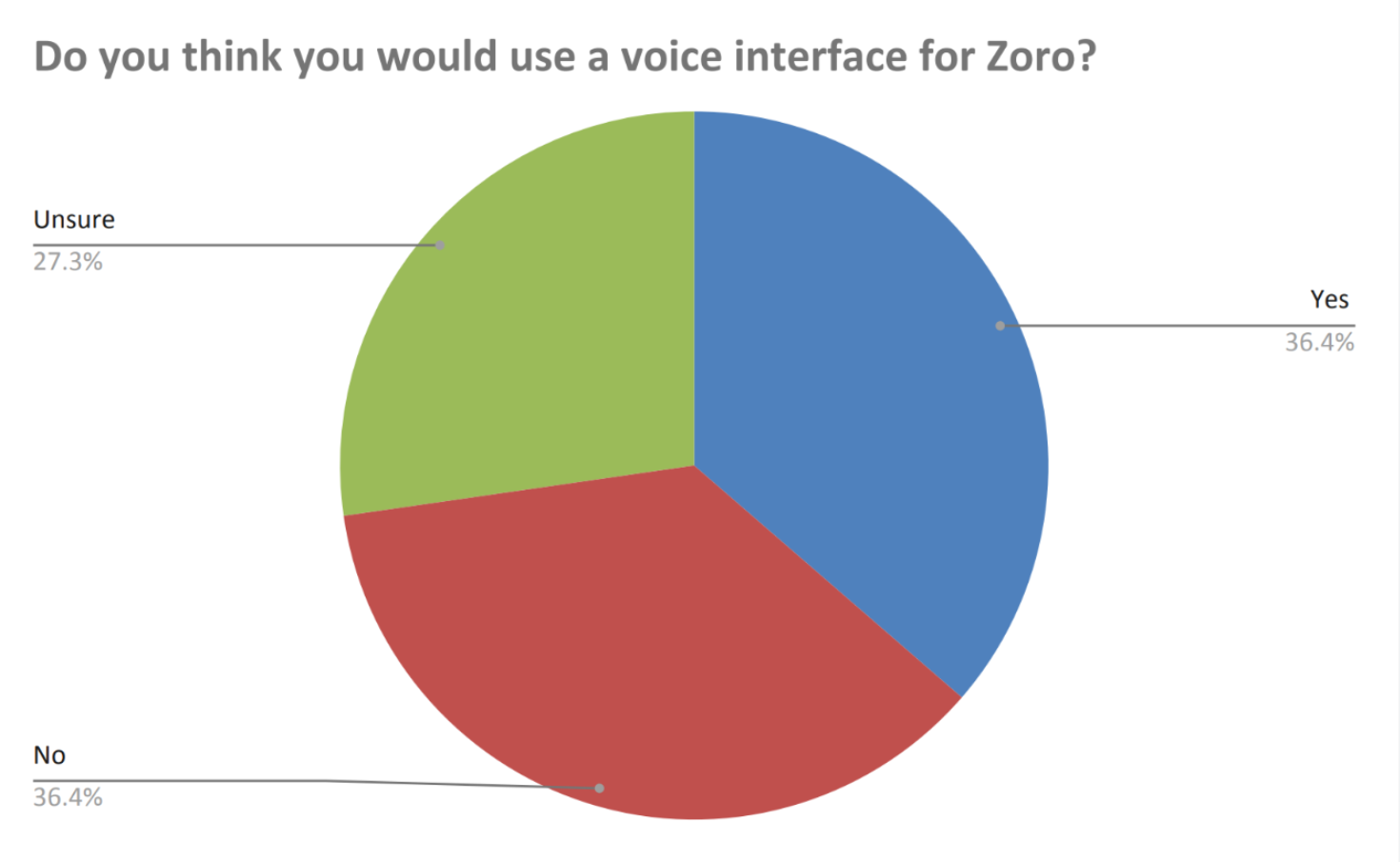
In the post survey, we inquired if any change in comfort level was experienced in their interaction. We also examined their confidence, frustration, satisfaction, difficulties when completing the tasks.

Analysis and Insights

Learnings and Reflection

Learned to collaborate within and outside of product teams across various functions and to be mindful and inclusive of multiple stakeholders.

Learned to handle multiple projects at the same time and prioritize.

Early and often feedbacks and meetings create a fruitful and trusting environment.

Learned to facilitate workshops, lead user research and usability study and influence the strategy.

It was insightful to use a combination of qualitative and quantitative research methodologies and connect insights from multiple sources.

Learned how to tie design metrics to business outcomes.

Thank you for visiting!

Made with sugar, spice and everything nice.